
Are Your Scrum Roles Driving Delivery or Creating Confusion?
In high-stakes technical environments, the biggest bottleneck usually isn’t complex code, legacy architecture, or a lack of engineering talent. It is role ambiguity. When organizations treat Scrum roles as mere corporate job titles instead of distinct, necessary accountabilities, velocity plummets and burnout spikes.
You see it in daily stand-ups that drag on for forty-five minutes. You see it in sprint planning sessions where developers are handed a predetermined list of tasks with zero context. You see it when the Scrum Master acts like a traditional project manager, nagging engineers for status updates.
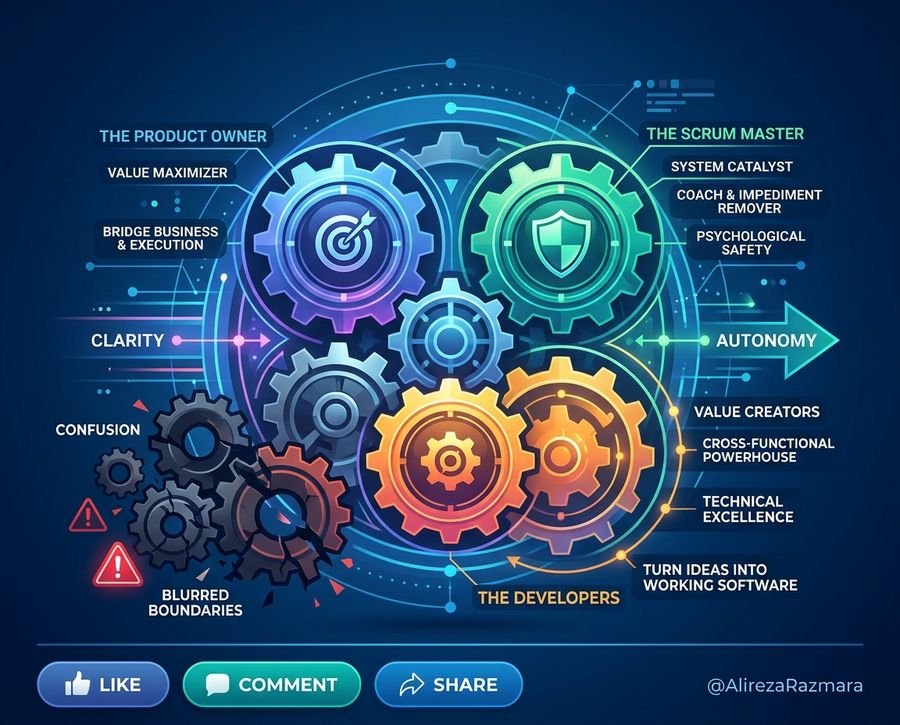
Scrum is not a hierarchy. It is a delivery engine powered by three perfectly balanced roles: the Product Owner, the Scrum Master, and the Developers. If one gear slips, or if one gear tries to do the job of another, the entire engine stalls. To achieve high-speed, sustainable delivery, you have to stop blurring the lines and start respecting the boundaries of these three distinct accountabilities.
The Product Owner: The Value Maximizer
The Product Owner is accountable for maximizing the value of the product resulting from the work of the Scrum Team. They hold the ultimate authority on what gets built and why the team is building it. They own the product backlog and ensure every item directly aligns with broader business goals.
In real-world delivery, effective Product Owners do not just act as scribes for stakeholders. They bridge the massive gap between high-level business strategy and ground-level technical execution. They spend their days analyzing market trends, talking to users, and translating those insights into a prioritized, actionable list of work.
Their absolute greatest superpower? The ability to say “no.” A great Product Owner aggressively protects the team’s focus and the product’s vision by rejecting distractions, vanity features, and stakeholder pet projects that do not deliver measurable value.
Signs of a Dysfunctional Product Owner
- The Proxy PO: They have no real authority to make decisions and must ask a committee or a senior executive before prioritizing work. This guarantees delivery delays.
- The Order Taker: They say “yes” to every stakeholder request, resulting in a bloated backlog and a Frankenstein product with no clear identity.
- The Dictator: They try to tell the Developers how to build the software, overstepping their boundaries into technical architecture.
The Scrum Master: The System Catalyst
The Scrum Master is accountable for establishing Scrum as defined in the Scrum Guide and improving the team’s effectiveness. They focus entirely on how the team flows, how they improve, and how they self-organize to deliver value sooner.
Let us clear up the most common industry misunderstanding right now: A Scrum Master is NOT a status reporter, an agile project manager, or a Jira administrator. If your Scrum Master spends all day pinging developers for status updates or just moving tickets across a digital board, you are wasting their potential.
They are true servant-leaders. This means they operate on multiple fronts. For the team, they act as a coach, helping Developers navigate conflict and build psychological safety. For the Product Owner, they help find techniques for effective product goal definition. For the wider organization, they are change agents who actively hunt down and remove systemic impediments that are slowing the team down.
Signs of a Dysfunctional Scrum Master
- The Team Secretary: They schedule all the meetings, take all the notes, and update all the tickets. This prevents the team from ever learning how to self-manage.
- The Taskmaster: They treat the Sprint Backlog like a binding contract and focus entirely on resource utilization and velocity metrics rather than value delivery.
- The Dogmatist: They care more about strictly following agile rules than they do about whether the team is actually shipping working software.
The Developers: The Value Creators
Developers in Scrum are the cross-functional professionals accountable for creating a usable, valuable Increment every single Sprint. They own the how. From system design and coding to testing and deployment, they dictate how the work actually gets done.
Do not let the word “Developer” fool you into thinking this just means software engineers writing backend code. In Scrum, a Developer is anyone contributing to the increment. Quality assurance engineers, UX designers, data analysts, and technical writers all wear the Developer hat. They are a self-managing powerhouse.
High-performing Developers do not wait to be assigned tasks. Once the Product Owner outlines the goal and the “why” for the Sprint, the Developers collaborate to figure out the best technical approach. They hold each other accountable for technical excellence, code quality, and meeting the Definition of Done.
Signs of Dysfunctional Developers
- The Siloed Specialists: The backend engineers refuse to look at frontend work, and the QA engineers sit idle until the very end of the Sprint. There is no swarming or shared accountability.
- The Feature Factory Workers: They blindly code whatever is on the ticket without asking questions about the business value or user experience.
- The Perfectionists: They constantly over-engineer solutions, delaying the release of value in pursuit of a flawless technical architecture that the business does not actually need yet.
The Leadership Reality Check: Why Boundaries Matter
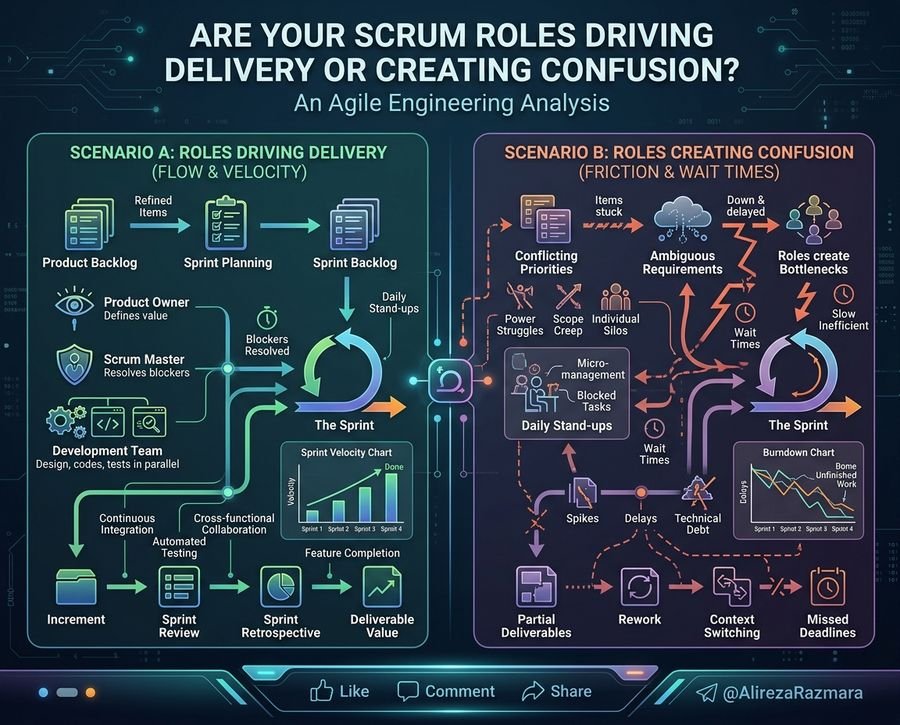
When these three roles respect their boundaries and master their unique accountabilities, autonomy thrives. Delivery becomes predictable. Customer satisfaction soars. It works because the system relies on healthy tension. The Product Owner pushes for more value. The Developers push back for technical quality and sustainable pace. The Scrum Master keeps the friction constructive and the process moving.
But what happens when you blur the lines? The entire system collapses.
Turn a Scrum Master into a taskmaster, and the Developers lose their self-managing edge. They stop taking ownership and wait to be told what to do. Have a Product Owner dictate the technical architecture, and you will end up with unscalable technical debt that takes months to untangle. Let Developers build whatever they want without Product Owner alignment, and you will build a technically brilliant product that absolutely no one wants to buy.
Agile transformations fail when leadership changes the job titles but keeps the exact same legacy behaviors. You cannot put a “Product Owner” label on a project manager, leave them in a rigid command-and-control hierarchy, and expect your delivery speed to magically double.
Clear Accountabilities Breed High-Performing Teams
If your delivery pipelines are sluggish, before you buy another enterprise tool or launch a massive department restructuring, take a hard look inside your sprint room. Are the roles actually clear? Is the Product Owner empowered to say no? Is the Scrum Master focused on systemic improvements rather than administrative tasks? Are the Developers trusted to manage their own technical execution?
Get the accountabilities right, and the speed will follow.
Which Role is the Most Misunderstood?
Every tech organization struggles with these boundaries at some point. Often, the Product Owner is stripped of authority, or the Scrum Master is reduced to a metric-tracker. In your experience on the ground, which of these three roles do you see being the most misunderstood or misapplied in tech organizations today? The answers usually point directly to the root cause of a company’s delivery bottlenecks.