

Listen In: Story Points vs Hours (18 min)
The Most Dangerous Trap in Agile Planning
Treating a story point as a fancy synonym for a specific number of hours is one of the most damaging mistakes an Agile team can make. When teams equate points to time, they immediately destroy the psychological safety, predictability, and efficiency that Agile frameworks are designed to build.
Let me guess. You are sitting in a Sprint Planning session. A developer looks at a ticket, scratches their head, and says, “That looks like about two days of work, so let’s call it a 5.” The Scrum Master updates Jira. Everyone nods in agreement. You move on.
You have just quietly killed your team’s agility. If one story point equals exactly four hours of work, why on earth are you not just using hours? We use points because human brains are notoriously terrible at absolute time estimation. We suffer from optimism bias. We forget about interruptions, context switching, mandatory meetings, code reviews, and uncooperative deployment pipelines. However, human beings are incredibly brilliant at relative sizing. It is time to stop mapping points to the clock and start treating estimation the way it was intended.
What Exactly is a Story Point?
A story point is a relative unit of measure used by Agile teams to express the total estimated effort required to complete a product backlog item. It is not a measurement of time, but rather a comparative metric that evaluates one piece of work against a known baseline.
Think of it like sizing fruit at the grocery store. You know an apple is bigger than a grape. You know a watermelon is significantly larger than an apple. You do not need a tape measure, a scale, or a calculator to figure that out. Your brain automatically compares the new item to an item you already understand. That is relative estimation.
When we ask developers to estimate in absolute hours, we are asking them to predict the future with perfect clarity. When we ask them to estimate in story points, we are simply asking, “Is this new login feature bigger or smaller than the password reset feature we built last month?” This dramatically reduces cognitive load and prevents endless arguments over whether a task will take four hours or six hours.
The 3 Pillars of a Story Point
A valid story point estimate must balance three core variables: complexity, risk, and volume of effort. When teams only look at time, they completely ignore the hidden friction that actually delays software delivery.
When your team sits down to play Planning Poker, they need to evaluate the work through these three specific lenses:
- Complexity: How hard is the logic or architecture? Updating a text string on a static web page has near-zero complexity. Refactoring a legacy payment gateway to support multiple international currencies is highly complex, requiring deep architectural thought before a single line of code is written.
- Risk and Uncertainty: What do we not know yet? Are we relying on an undocumented third-party API? Is this a brand-new technology stack for the team? High uncertainty immediately bumps up the point value. Even if the actual keystrokes seem minimal, the risk of falling down a technical rabbit hole justifies a larger estimate.
- Effort (Volume): How much sheer physical work is required? Painting one wall is low effort. Painting fifty identical walls is high effort. The complexity is exactly the same, but the sheer volume of work demands a higher point value.
How Do You Actually Calculate Story Points?
You do not calculate story points using a formula; you establish them through team consensus using relative comparison against a baseline. The most effective and proven method is combining Planning Poker with the Fibonacci sequence.
The process of establishing points should never involve a calculator. Here is how highly mature Agile teams execute relative sizing in the real world:
1. Establish a Baseline: Pick a simple, well-understood user story from your backlog. It should be a task that everyone on the team grasps easily. Label this a “2” or a “3”. This becomes your anchor. Every future estimate will be compared against this specific ticket.
2. Use the Fibonacci Sequence: Have the team vote on new tickets using numbers that scale non-linearly (1, 2, 3, 5, 8, 13…). The gaps between the numbers force a decision. A task is either a 5 or an 8. It prevents teams from nitpicking over minor differences, which is what happens when you estimate in hours.
3. Compare and Align: Look at the new backlog item. Ask the team, “Is this roughly twice as complex, risky, and laborious as our baseline task?” If the answer is yes, it is a 5. If they think it is similar in size to an 8-point story completed last sprint, it is an 8. You are triangulating size based on past shared experiences.
The Leadership Trap: Why Managers Demand Hours
Leaders often force point-to-hour conversions because traditional project management demands absolute precision for budget, timeline forecasting, and resource allocation. They want a neat, tidy roadmap, and relative points feel far too abstract to present to a board of directors.
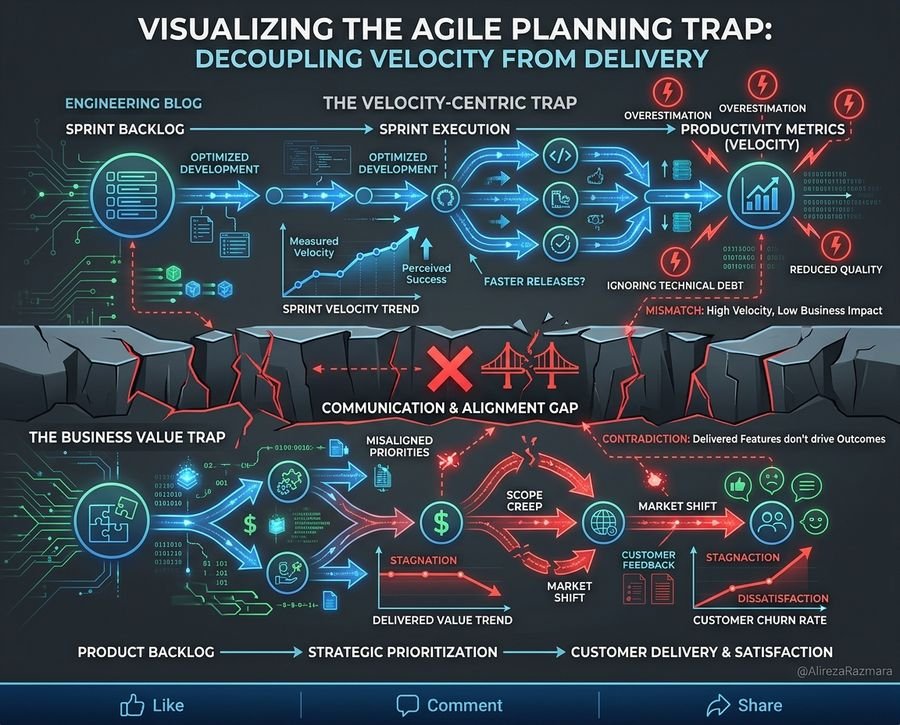
This desire for absolute time estimates is an illusion of control. Predictability in software engineering does not come from micromanaging hourly estimates at the task level. Predictability comes from tracking a team’s velocity trendline over time.
If a cross-functional team consistently completes 40 points per sprint over five sprints, you have a highly predictable delivery engine. You know exactly what fits into the next sprint without ever needing to know how many hours a “5” takes. As soon as a well-meaning manager steps in and says, “We need 55 points next sprint, and since a point is 4 hours, we just need everyone to work a little weekend overtime,” the system breaks.
The team will immediately adapt defensively. They will start inflating their estimates to protect themselves. A standard 3-point story suddenly becomes a 5. A 5 becomes an 8. Velocity goes up on paper, but actual software delivery remains completely stagnant. You have achieved nothing except corrupting your own metrics.
Why Absolute Time Fails Cross-Functional Teams
Estimating in hours punishes efficiency, ignores the reality of modern developer workflows, and creates an unintentional culture of micromanagement and individual blame.
Consider a senior engineer and a junior engineer looking at the same ticket. If you estimate in hours, the senior dev might say it takes 2 hours. The junior dev might say it takes 12 hours. Who is right? They both are, based on their individual skill levels. But if you assign a time-based estimate to the ticket, you create massive friction. If the senior finishes it quickly, management assumes the estimate was padded. If the junior struggles, they feel incompetent and management asks why the sprint is lagging.
Story points abstract the individual away from the estimate. The team owns the points. A 5-point story is a 5-point story regardless of who picks it up from the board. It represents the size of the rock, not the strength of the person pushing it. If a junior engineer takes it, it will take more physical time, but the team’s overall historic velocity inherently absorbs that variance.
Actionable Steps to Break the Habit
To stop converting points to hours, Agile coaches and Scrum Masters must re-educate stakeholders on velocity trendlines, enforce strict baseline comparisons during planning, and protect developers from time-tracking scrutiny.
Breaking this ingrained habit requires deliberate facilitation and a shift in team culture. Here is how you can guide your organization away from absolute time:
- Ban Time Equivalents in Planning: If a developer says, “That looks like a day of work,” politely pause the conversation. Pivot immediately by asking, “How does this compare to the database migration ticket we did last week?” Force the relative comparison.
- Shift Focus to Predictability, Not Output: Educate leadership that velocity is purely a capacity planning tool, not a performance metric. You do not manage velocity; you manage the environment to allow velocity to stabilize naturally.
- Normalize Uncertainty as a Refinement Trigger: Use larger point sizes (like 13 or 21) as immediate triggers for backlog refinement. If a story is an 8 or higher, it is too big, too complex, or too risky. Break it down. Do not ask how many hours it will take; ask what architectural answers are needed to reduce the risk to a 3.
Story points belong to the team, not to management. They are a defensive mechanism against burnout, a foundation for psychological safety, and the key to long-term predictable Agile delivery. Stop asking your developers to justify their points in hours. Trust the relative scale, track your trendlines, and watch your delivery predictability stabilize.