

Listen In: The 80 20 Rule for Technical Debt (21 min)
Walk into almost any Sprint Planning session, and you can instantly read the room. Sometimes, it is suspiciously quiet—a sign of disengagement. Other times, it is a battlefield.
Most organizations treat conflict like a system failure. They see raised voices and tense body language, and leadership immediately tries to de-escalate. As a Technical Project Delivery Consultant and Agile Coach, I view these moments through a completely different lens. Conflict isn’t a bug in Agile. It is a feature.
A few Sprints ago, I walked into a total deadlock. Our Lead Architect and Product Owner were at war. The Architect demanded a full Sprint dedicated exclusively to refactoring legacy code, citing a fragile microservices architecture that was ready to snap. The Product Owner insisted on delivering five new client-requested features to hit a crucial quarterly KPI tied to revenue. Tension was high. Voices were undeniably raised. The development team sat frozen, caught in the crossfire between business demands and engineering realities.
My job wasn’t to pick a side. It was to leverage the friction to build a stronger system.
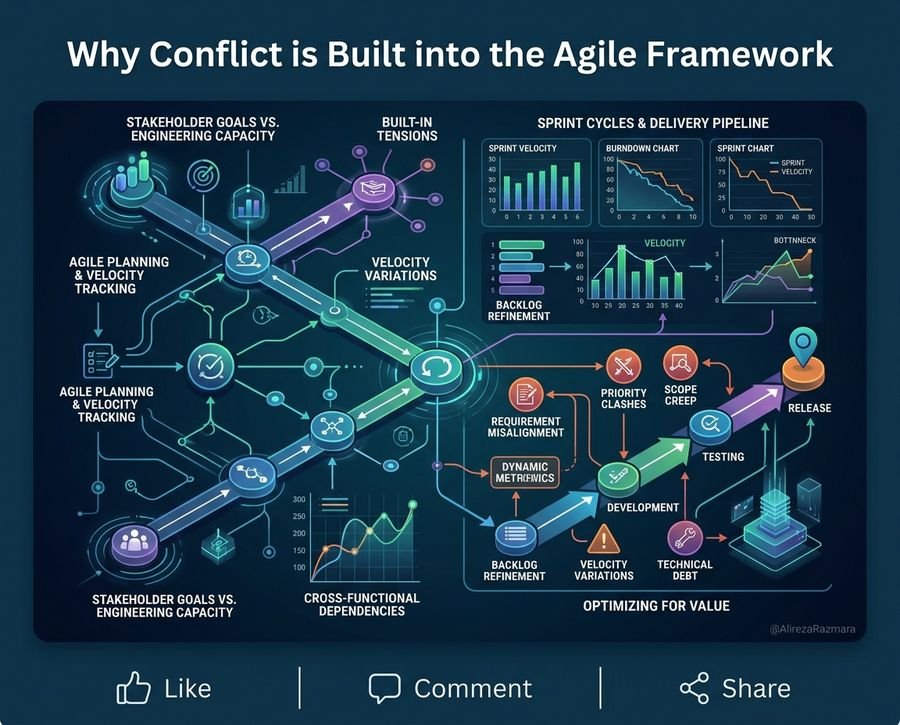
Why Conflict is Built into the Agile Framework
Conflict in Agile is a deliberate structural tension designed to balance competing priorities. It prevents teams from over-indexing on short-term features at the expense of long-term stability, and vice versa. The framework intentionally pits different roles against each other to ensure all perspectives are validated.
Think about the inherent design of a Scrum team. The Product Owner is incentivized by market value, customer satisfaction, and fast delivery. They want it now. The Developers and Architects are incentivized by code quality, system integrity, and low maintenance overhead. They want it built right. The Scrum Master advocates for process efficiency and a sustainable pace. They want the team to survive the marathon.
When these three distinct forces collide, friction is the only logical outcome. If everyone in your planning events simply nods along with the loudest voice in the room, you do not have alignment. You have apathy. Artificial harmony kills software products far faster than bad code. Embracing this tension is the first step to mature Agile delivery.
Navigating the Classic Deadlock: Technical Debt vs. Feature Delivery
The tug-of-war between new features and technical debt is the most common battleground in software engineering. When the stakes are high and deadlines are looming, this debate often degenerates into an emotional standoff.
In the scenario with our Architect and PO, the disagreement had stalled the entire Sprint Planning event. We were burning valuable time, and morale was dropping by the minute. To break the deadlock, we implemented a four-step framework that transformed the argument into a collaborative problem-solving session.
Step 1: Pivot from Positions to Outcomes
Shifting from positions to outcomes means changing the argument from what each person wants to why the business needs it. You must reframe the vocabulary of the conversation to find common ground.
During our standoff, the debate was stubbornly framed as “Tech Debt vs. Features.” This framing creates a zero-sum game where one person inevitably loses. I stepped in and wiped the whiteboard clean. I wrote two new phrases: System Reliability vs. Market Speed.
This simple pivot changed the entire dynamic. The Product Owner could not argue against the necessity of system reliability. A crashed application generates zero revenue. Conversely, the Architect could not ignore the immediate need for market speed. Perfect code that ships after the market window closes is useless. By elevating the language from tactical demands to strategic business outcomes, we removed personal egos from the equation.
Step 2: Objectify the Value Using Cost of Delay
Cost of Delay quantifies the financial and operational impact of not executing a specific piece of work right now. It forces highly emotional debates into the cold, objective realm of empirical data.
We stopped raising our voices and started mapping the realities of the product backlog. I asked the room two direct questions: What exactly happens if we ignore this architectural tech debt for another quarter? What exactly happens if we delay these five client features for another month?
We visualized the answers. The engineering data showed that if we ignored the legacy code constraints, our feature delivery speed would drop by an estimated 40% in the following quarter due to severe integration bottlenecks. The business data showed that delaying the features meant risking immediate churn from two enterprise clients. Objectifying the conflict proved that both leaders had valid fears. Once they saw the data mapped out, they stopped fighting each other and started fighting the problem.
Step 3: Guard Psychological Safety in Heated Debates
Psychological safety exists when team members can fiercely debate ideas, challenge assumptions, and express dissenting views without fear of personal backlash or professional retaliation. It is the absolute boundary line between productive friction and toxic infighting.
As the volume in the room initially peaked, I paused the meeting to reset the ground rules. The directive was simple: We will be brutally hard on the problem, but strictly soft on the people. Passionate disagreement was expected and actively welcomed. However, interruptions, eye-rolling, and questioning a colleague’s underlying motives were completely off-limits.
When a team knows the guardrails are secure, their defense mechanisms drop. They transition from preparing their next counter-argument to actively listening to their peers. You do not want an Agile team that is afraid to argue. You want a team that knows exactly how to argue effectively.
Step 4: Co-Create a Sustainable Allocation Policy
A sustainable allocation policy establishes a non-negotiable, standardized baseline for balancing different categories of work in every single iteration. It prevents the team from having to fight the exact same battle at the start of every Sprint.
Reaching a compromise on a single Sprint is just a temporary band-aid. We needed a systemic fix. Working collaboratively, the PO, the Lead Architect, and the developers agreed to institute an 80/20 capacity allocation rule. Moving forward, 80% of our available Sprint capacity was fiercely dedicated to customer value, new features, and bug fixes. The remaining 20% was strictly locked in for technical debt reduction, infrastructure upgrades, and architectural refactoring.
This rule was baked into our working agreements. No exceptions, even under stakeholder pressure. The Product Owner felt secure knowing a steady stream of features would consistently flow to the market. The Architect felt secure knowing the underlying system would incrementally heal. The chaotic tug-of-war was finally replaced by a predictable, sustainable rhythm.
Common Anti-Patterns When Managing Agile Conflict
Failing to manage structural tension usually results in one of three highly destructive anti-patterns. Recognizing these behaviors early is critical for Agile leaders.
- The Dictator PO: The Product Owner uses business pressure to override all technical concerns. The result is a rapid build-up of technical debt that eventually brings delivery to a grinding halt.
- The Ivory Tower Architect: Engineering leadership demands perfection, refactoring code endlessly without tying the effort to tangible customer value. The result is a beautifully engineered product that ships far too late.
- The Passive Scrum Master: The facilitator steps back to avoid uncomfortable confrontations, allowing the loudest voice in the room to dictate the Sprint Backlog. The result is a completely disempowered development team.
The Measurable ROI of Managed Conflict
Teams that manage conflict effectively deliver higher-quality products while consistently hitting their delivery targets. They do not sacrifice tomorrow for today, nor do they stall today’s growth in pursuit of tomorrow’s perfection.
The business results of our 80/20 allocation policy spoke for themselves. By the end of the quarter, the team successfully shipped the five critical features, allowing the business to hit its revenue KPI. Simultaneously, the steady, incremental refactoring efforts paid off massively, reducing critical production bugs by a measured 30%. Delivery predictability stabilized.
Perhaps most importantly, the professional relationship between the Product Owner and the Lead Architect completely transformed. They stopped viewing each other as adversaries competing for limited resources. Instead, they began operating as strategic partners, navigating the complexities of product development as a unified front.
Transforming Friction into Strategic Clarity
Agile frameworks do not exist to make everyone feel comfortable. They exist to surface problems quickly so that intelligent professionals can solve them. Great tech leadership is never about avoiding conflict. Avoidance only breeds hidden resentment, silent failure, and massive technical debt.
True Agile leadership is about converting raw emotional energy into strategic clarity. The next time voices get raised during your Sprint Planning, Backlog Refinement, or Retrospective, do not panic. Do not immediately shut the conversation down. Lean into it. Objectify the data, heavily protect the psychological safety of the people involved, and let the inherent structural tension of Agile do exactly what it was designed to do: drive absolute innovation.