
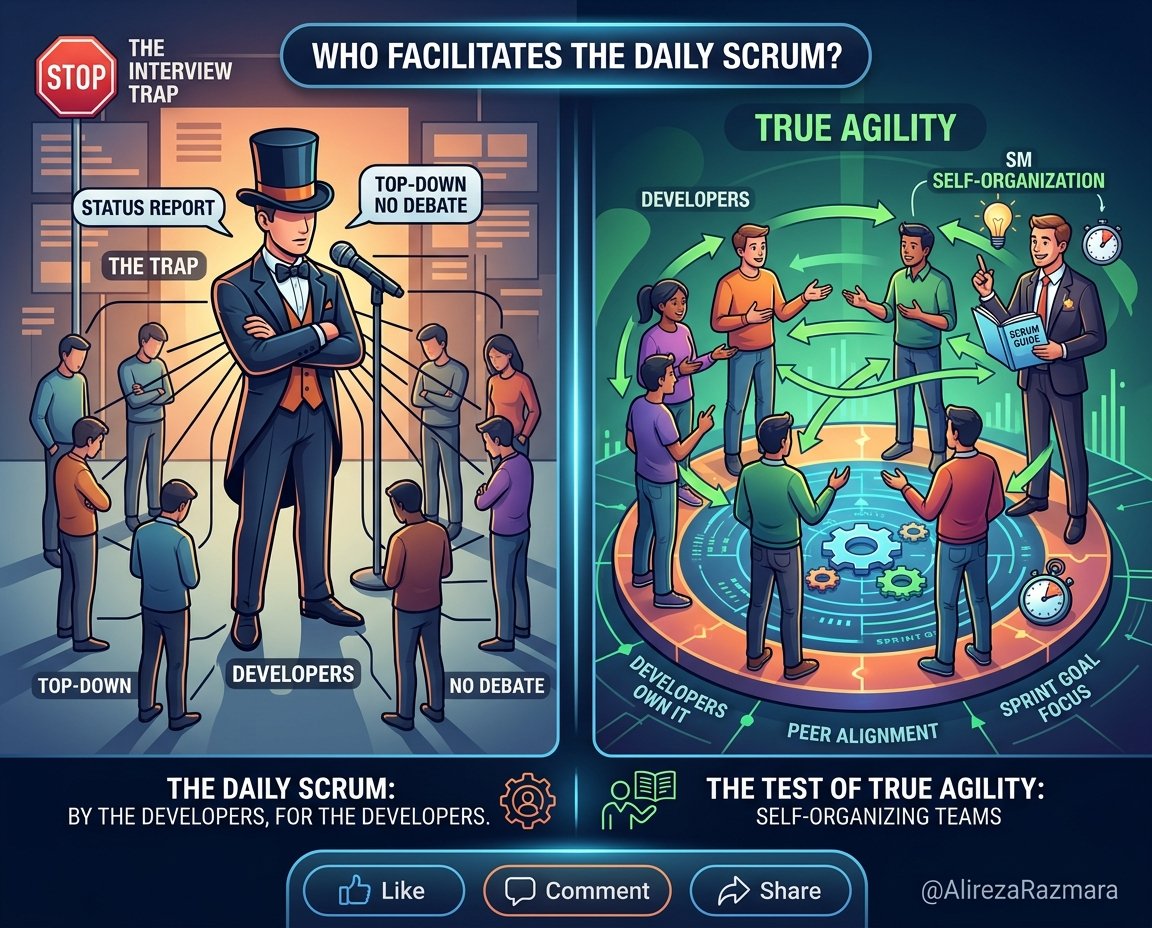
The Ultimate Litmus Test for True Agility
Have you ever sat across the table in an interview for a senior delivery role and heard this deceptively simple question: “Who facilitates the Daily Scrum?”
If your reflex is to answer “The Scrum Master,” we need to have a serious conversation about your agile practice. Over years of coaching technical teams and leading enterprise transformations, I use this single question to instantly diagnose whether an organization is practicing true agility or just running waterfall status meetings in disguise.
Let us clear the air immediately. The Scrum Master does not facilitate the Daily Scrum. That is a dangerous anti-pattern that slowly suffocates team self-organization. If you want to build high-performing software teams, you must fundamentally rethink how this 15-minute event operates.
Who Actually Facilitates the Daily Scrum?
The Developers facilitate the Daily Scrum. According to the Scrum Guide—and proven by every high-performing agile team in the field—this event is created by the Developers, for the Developers. It is their dedicated space to inspect progress toward the Sprint Goal and adapt their plan for the next 24 hours.
It is not a status update to leadership. It is a daily strategic planning session.
When a Scrum Master, Project Manager, or Tech Lead steps in to facilitate every morning, the entire dynamic of the room shifts. Instead of a collaborative problem-solving session between peers, the event morphs into a top-down reporting ceremony. True agility relies on peer-to-peer accountability, and that only emerges when the people doing the work own their synchronization.
The Symptoms of a Status Meeting Daily Scrum
You can spot a broken Daily Scrum within the first three minutes. The most obvious indicator is eye contact: if the developers are looking exclusively at the Scrum Master or Product Owner while they speak, you are running a status meeting, not a Scrum event.
Here are the clear red flags I look for when auditing a team’s agile maturity:
- The Round-Robin Roll Call: The Scrum Master calls on people one by one, usually alphabetically or by who joined the Zoom call first.
- Defending the Timesheet: Developers list every single meeting they attended and email they sent yesterday to prove they were busy, rather than focusing on the Sprint Goal.
- The Quiet Audience: When one developer speaks, the rest of the team tunes out because the update does not impact their work.
- Problem-Solving in the Weeds: The team spends ten minutes diagnosing a single bug, blowing past the 15-minute timebox while half the team waits in silence.
- Cancellation by Absence: If the Scrum Master is out sick, the team skips the meeting entirely.
The Trap: Why Leaders Default to Facilitating
Leaders naturally step in to facilitate because it feels productive and maintains a comfortable sense of control. For transitioning Project Managers, letting go of the daily update is often the hardest part of adopting the Scrum Master accountability.
You want to help. You want to make sure the meeting happens efficiently. You want to know what everyone is working on so you can report up the chain. But this desire for control directly undermines the team’s ability to self-manage.
When you pull the strings, the team becomes dependent on you. They stop talking to each other and start reporting to you. You become the central node in a network that is supposed to be decentralized. This is how you accidentally build a brittle team that falls apart the moment you are out of the office.
How Developers Should Run the Daily Scrum
Developers should structure the Daily Scrum in whatever way best helps them inspect progress and adapt their upcoming work. There is no mandated format. The 2020 Scrum Guide explicitly removed the classic “three questions” (What did I do yesterday? What will I do today? Are there blockers?) because they too easily degraded into a robotic status report.
While the three questions can work as training wheels for new teams, mature teams usually outgrow them. Instead, they prefer Walking the Board.
Walking the board means starting with the work items closest to completion (the right side of the Kanban or Jira board) and asking, “What do we need to do as a team to get this to ‘Done’ today?” This immediately shifts the focus from individual busyness to team delivery. The developers dictate the flow, call out dependencies, and actively alter their plan for the day.
What is the Real Role of the Scrum Master During the Daily Scrum?
The Scrum Master’s role is to ensure the Daily Scrum takes place and stays within the 15-minute timebox. They achieve this by teaching the Developers how to run the event effectively, not by running it for them.
Think of the Scrum Master as a sports coach during a live game. The coach does not run out onto the field and throw the ball. They observe from the sidelines, note anti-patterns, and provide feedback during practice—or in the agile world, during the Sprint Retrospective.
During the Daily Scrum, a great Scrum Master is highly active in their observation, but quiet in their participation. They listen for hidden impediments. They watch team dynamics. If the team starts spiraling into a deep technical debate, the Scrum Master might intervene with a quick, “Sounds like a great topic for the parking lot. Let’s finish our alignment first.” Otherwise, they stay out of the way.
The Vacation Test: Measuring True Agile Self-Organization
The ultimate test of a Scrum Master’s success is whether the Daily Scrum happens with high energy and value when they go on vacation. If the event fails to happen in your absence, you have not built a self-managing team.
A high-performing team views the Daily Scrum as an indispensable tool for their own success. They do not need a babysitter to ensure they synchronize their work. They run it themselves because failing to do so makes their jobs much harder.
If you want to test your team’s current maturity, try stepping back tomorrow morning. Tell the team you are just observing today and say nothing. Watch the awkward silence, let them fill it, and see who steps up to guide the conversation. The results will tell you exactly where your coaching needs to focus next.
Actionable Steps to Transition Ownership
Handing over facilitation requires a deliberate, phased approach. You cannot simply drop the mic and walk away if the team relies on you to run the show. Use these proven tactics to slowly transfer ownership to the developers:
- Stop Sharing Your Screen: If you are the one driving the Jira or Azure DevOps board, you hold the power. Ask a different developer to share their screen and navigate the board each day.
- Break the Eye Contact Habit: When a developer gives their update while staring directly at you, look down at your notebook or physically turn your body toward another team member. Force them to address their peers.
- Change Your Position: If you are co-located, stand at the back of the room rather than the front. If you are remote, join the meeting two minutes late so the team is forced to start without you.
- Use the Retrospective: Bring up the Daily Scrum in your next Sprint Retrospective. Ask the team, “Is our current Daily Scrum helping us achieve the Sprint Goal, or does it feel like a status update? How do you want to run it?”
Stop Managing and Start Empowering
True agile leadership isn’t about running every meeting or having all the answers. It is about building a resilient ecosystem that runs seamlessly without you at the center.
The next time you log into your morning synchronization, take a deep breath, mute your microphone, and let the team figure it out. Step back, empower your developers, and watch their sense of ownership skyrocket.