
Why Does Velocity Drop When the Team Stays Silent?
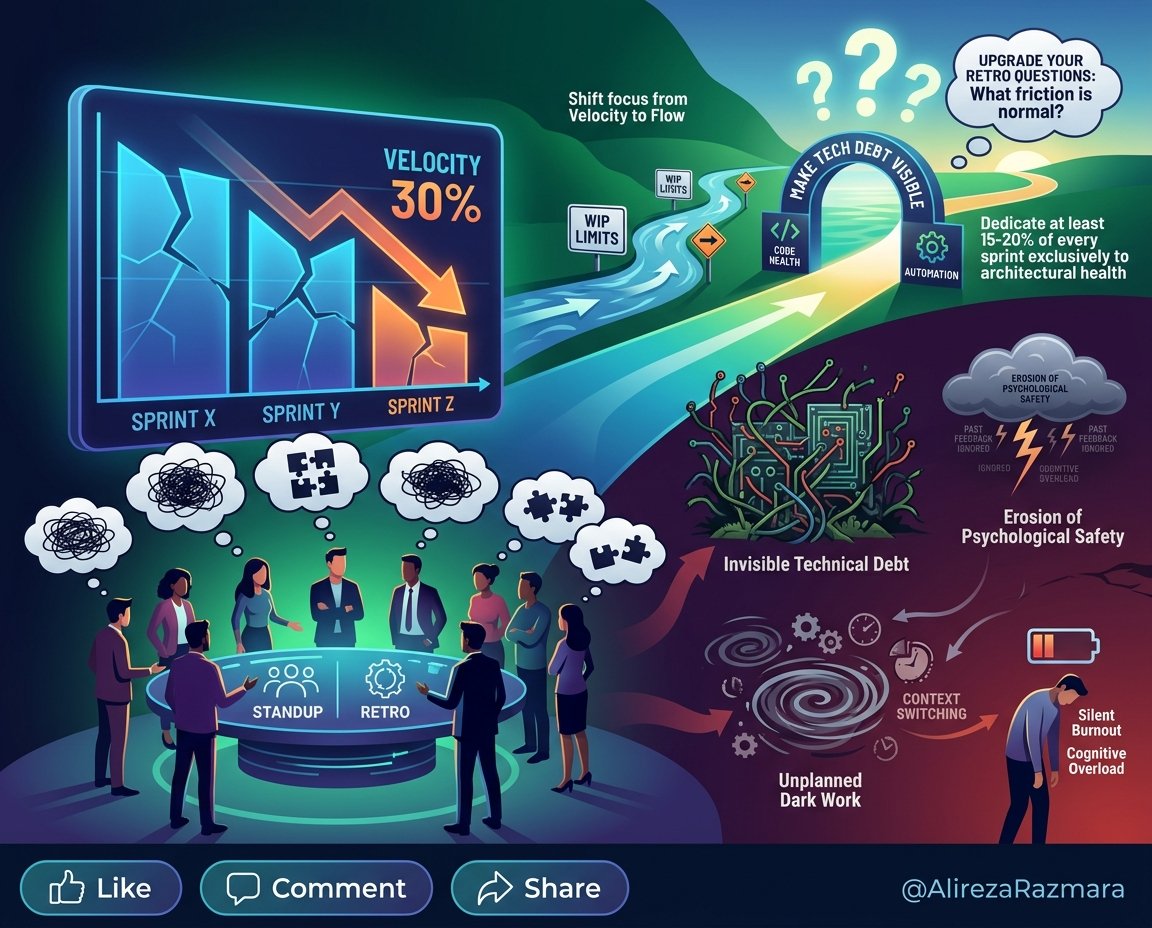
Teams claim they have “no blockers” during a velocity drop because they are either fighting invisible friction they have accepted as normal, or they lack the psychological safety to speak up. The silence usually masks unmanaged technical debt, undocumented “dark work,” or team burnout.
You pull up your sprint metrics. Velocity has dropped 30% over the last three sprints. Yet, during every daily standup and retrospective, the team reports the exact same thing: “Everything is fine. No blockers.”
Should you be concerned? Yes. Absolutely. A drop in velocity on its own is rarely a crisis. Velocity is a planning metric, not a measure of productivity. But when velocity drops and the team is completely silent, you aren’t dealing with a simple estimation issue. You have a visibility or culture problem on your hands. Let’s break down exactly what is happening behind that silence.
Invisible Technical Debt
The codebase has grown fragile. Developers aren’t blocked by external teams or waiting on vendor approvals. Instead, they are fighting legacy spaghetti code, slow CI/CD pipelines, or a total lack of test automation. Every minor feature takes three times longer than it should because they are carefully navigating around broken architecture. They don’t report this as a “blocker” because, to them, it is just the daily reality of doing the job.
Erosion of Psychological Safety
If past feedback was consistently ignored, teams enter a state of learned helplessness. They stop raising impediments because they fundamentally believe management will not address systemic issues anyway. Why complain about a slow testing environment if you brought it up in the last five retrospectives and nothing changed? They put their heads down and suffer in silence.
Unplanned “Dark Work” and Context Switching
Critical bugs, Slack-based “quick favors” from stakeholders, and poorly refined acceptance criteria are eating up 40% of their focus. Because this work is not tracked in Jira or Azure DevOps, it remains invisible to leadership. The slowdown is intensely real, but the metrics only show a team completing fewer story points.
Cognitive Overload and Silent Burnout
A tired team naturally slows down to protect itself. Sustainable pace is not just a catchy Agile slogan; it is a hard physiological limit. When developers are context-switching across five different priorities, their cognitive load maxes out. They aren’t explicitly blocked by a missing dependency. They are blocked by mental exhaustion.
The Danger of Weaponizing Velocity Metrics
Weaponizing velocity by using it as a performance metric guarantees that teams will game the system. When velocity becomes a management target, it completely loses its value as a predictability and planning tool.
There is a famous economic principle called Goodhart’s Law. It states that when a measure becomes a target, it ceases to be a good measure. If you penalize an Agile team for a 30% drop in velocity, they will instantly figure out how to give you the numbers you want without actually improving their output.
They will start padding their estimates. A straightforward task that used to be a 2-point story will suddenly be pointed at a 5. They will break down features into artificially small, non-deliverable slices just to move tickets across the board faster. In the end, the velocity chart will look absolutely fantastic to upper management, but actual working software delivery will continue to stagnate.
This is why servant leadership is critical. You must explicitly tell the team that a drop in points is not a failure, but a system signal. Make it clear that you are looking for the friction causing the slowdown, not looking to punish the people doing the work.
What to Do Instead of Asking for “More Story Points”
Never react to a velocity drop by demanding more output. Instead, shift your focus to flow metrics, ask better retrospective questions, and make technical debt highly visible in your product backlog.
If you walk into a retro and tell the team they need to pull more points next sprint, you will only guarantee that they inflate their estimates. Here is how you actually fix the root cause.
Shift Focus From Velocity to Flow Metrics
Stop obsessing over the sprint aggregate. Start looking at Cycle Time, Lead Time, and Work in Progress (WIP) limits. Are stories sitting in “In Review” for four days? That is your silent blocker. Enforce strict WIP limits to force the team to finish old work before starting new work. When developers cannot pull new tickets because the WIP limit is hit, the real bottlenecks instantly become visible.
Upgrade Your Retrospective Questions
Stop asking the generic “What went wrong?” or “What didn’t go well?” When a team is accustomed to pain, they will not classify a fragile deployment process as “wrong”—they just think it is normal.
Change your prompt. Ask: “What friction have we accepted as ‘normal’ that we really shouldn’t?” Or try: “If you had a magic wand to fix one annoying part of your daily workflow, what would it be?” This bypasses defensiveness and gets straight to the systemic issues hiding under the surface.
Make Technical Debt Visible
If developers are fighting bad code, give them the capacity to fix it. Dedicate at least 15% to 20% of every sprint exclusively to architectural health, refactoring, and tooling improvements. Put these technical debt items on the board right next to product features. When leadership treats system health as first-class work, developers feel empowered to flag bad code before it causes a major sprint slowdown.
How to Investigate a Quiet Velocity Drop (Without Micromanaging)
The first thing you should investigate during a quiet velocity drop is the ratio of planned versus unplanned work, followed immediately by examining the age of active items on your Kanban or Scrum board.
As an Agile Coach, Scrum Master, or Delivery Manager, your job is to play detective, not dictator. You need to observe the system and gather evidence before making accusations of low productivity.
- Audit the Side Channels: Check Slack, Teams, or email channels for developer support requests, hotfixes, or direct messages from product owners asking for “tiny tweaks.” If you find a massive shadow economy of un-ticketed work, bring this data to the team. Offer to act as a shield. Tell them, “I noticed a lot of side requests this week. From now on, route those to me so you can focus.”
- Review the Code Integration Process: Look at your pull request (PR) process. Is the code written quickly but languishing in a queue waiting for approvals? Often, a velocity drop is just a symptom of a highly constrained senior engineer who is acting as the single point of failure for all code reviews.
- Have Informal One-on-One Conversations: Group settings like retrospectives can be intimidating for engineers who don’t want to sound like complainers. Grab a coffee—virtual or physical—and ask a simple, non-threatening question: “You guys are working incredibly hard, but the board makes it look like things are stalling. What is the board missing?”
The Hard Truth About Agile Predictability
Velocity metrics do not lie, but silence frequently hides the real bottlenecks. If your team stops talking, your absolute first priority is restoring trust and removing systemic friction, not maximizing output.
Tracking story points in Jira is easy. Building an engineering culture where developers feel safe enough to say, “This code is a mess and I am struggling,” is exceptionally hard work. When you face a silent velocity drop, resist the urge to crack the whip. Look closely at the system, address the invisible technical constraints, and watch how quickly the speed returns once the silent blockers are finally cleared.