🎧 Listen in: Should You Throw Away Your MVP Code (19 min)
Stop Confusing Your MVP With Your MMP
Stop confusing your MVP with your MMP. It is silently killing your product runway and frustrating your market. As Agile leaders, we champion learning fast and failing fast. But let’s get a reality check straight from the trenches. A failed experiment is just an MVP doing exactly what it was designed to do. A broken, buggy release marketed to paying customers is an MMP gone terribly wrong.
Too many teams build a Minimum Viable Product, push it to production, call it “Done,” and expect commercial success. It rarely happens. Treat an MVP like a launch-ready product, and you sacrifice quality and brand trust. Treat an MMP like a science experiment, and you waste valuable sprints over-engineering assumptions.
Let’s clarify the distinction once and for all so you can protect your developers, align your stakeholders, and actually build products people want to buy.
What is an MVP (Minimum Viable Product)?
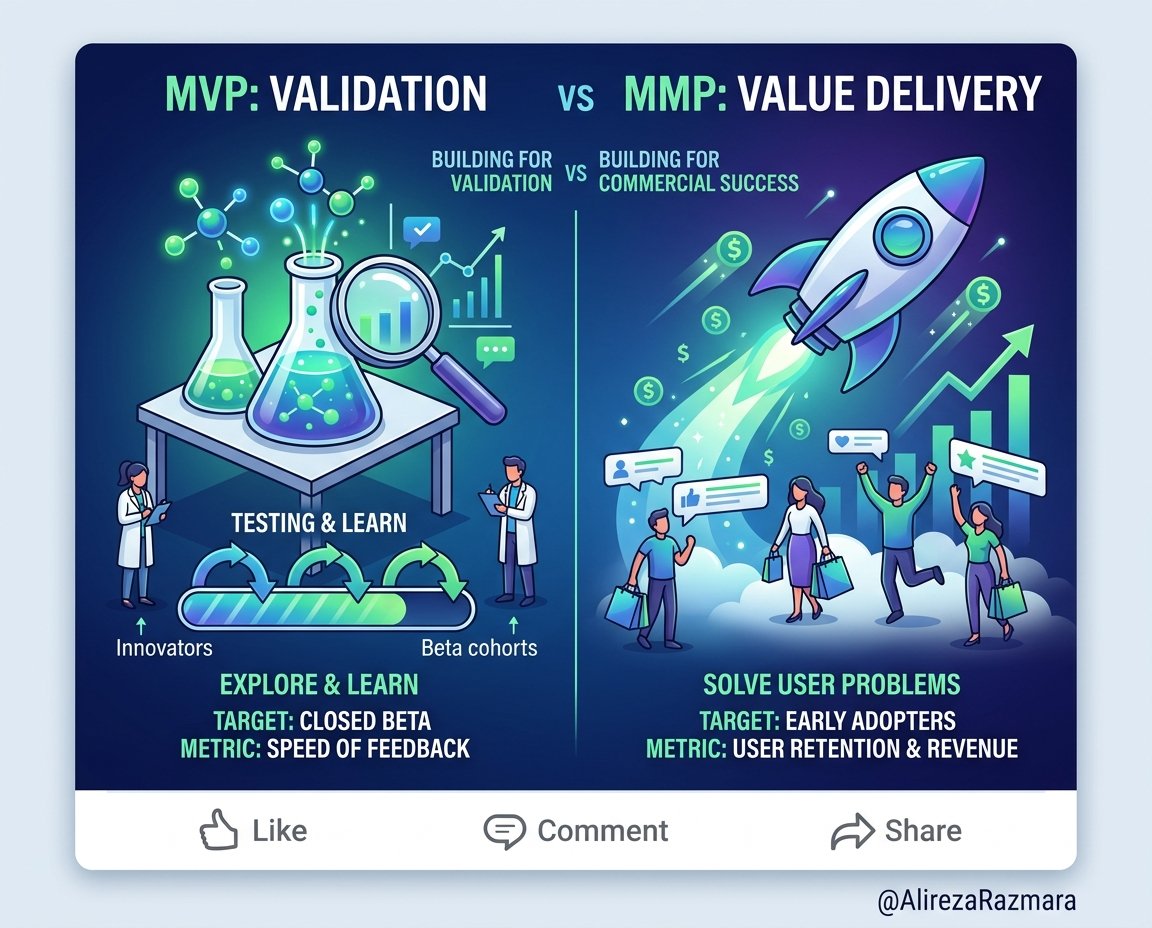
An MVP is a validation mechanism designed to maximize learning with the absolute minimum effort. It is an experiment to test core business hypotheses, not a polished software release intended for broad commercial consumption. When you build an MVP, your primary goal is discovery. You need to know if the problem you think exists actually exists, and if your proposed solution resonates with real human behavior.
Your target audience here isn’t the general public. It consists of innovators, design partners, and closed beta cohorts who are willing to forgive rough edges because they desperately need a solution to their problem. They want the pain to stop, and they will tolerate a clunky interface if it helps them.
The success metric for an MVP is the speed of feedback. You are measuring hypothesis validation and gaining the clarity needed to pivot or persevere.
- Primary Goal: Maximize validated learning with minimal effort.
- Target Audience: Innovators, design partners, and closed beta users.
- Success Metric: Speed of feedback, hypothesis validation, and pivot clarity.
- Mindset: Quick, scrappy, and purely scientific.
Your MVP does not need clean architecture. It does not need scalable code. In many cases, it doesn’t need code at all. A clickable prototype, a high-converting landing page, or a manual concierge flow operating behind the scenes is often enough to prove demand. If your team is spending three months writing microservices for an MVP, you have entirely missed the point.
What is an MMP (Minimum Marketable Product)?
An MMP is the earliest version of your product that solves a real user problem well enough to create market traction and generate revenue. Unlike an MVP, an MMP requires refined execution, security, and reliability because it is built to be sold to early adopters and paying customers. This is where value delivery takes center stage.
Your primary goal shifts from validating assumptions to solving a concrete problem effectively. The people using an MMP expect a working, functional, and secure experience. They are paying you—either with their budget or their valuable time—and their tolerance for broken workflows is extremely low.
Success metrics change dramatically at this stage. You are no longer just looking for feedback; you are tracking user retention, customer satisfaction scores (NPS), and actual revenue growth.
- Primary Goal: Solve a real user problem well enough to create market traction.
- Target Audience: Early adopters and paying customers.
- Success Metric: User retention, customer satisfaction, and revenue.
- Mindset: Highly refined, secure, reliable, and commercially viable.
An MMP usually has a deliberately narrow scope. It might only do one or two things. But what it does, it executes brilliantly. You leave out the nice-to-have bells and whistles, but the core features shipped must be stable, fast, and reliable.
The Fatal Consequences of Mixing Them Up
Treating an MVP like an MMP destroys your brand reputation and customer trust. Conversely, treating an MMP like an MVP drains your startup runway and stalls your time to market. You must keep the boundaries distinct.
Let’s look at the first scenario. You take your messy, hacked-together MVP and market it to the public as a finished solution. What happens? Paying customers sign up, hit a bug, get frustrated, and leave. You sacrificed quality for speed, and now the market thinks your company builds subpar software. Once a user churns due to a terrible first experience, winning them back costs exponentially more than acquiring them the first time. Your sales team loses confidence, and support ticket queues explode.
Now consider the opposite. You treat an MMP like a science experiment. You spend six months and half a million dollars building a fully scalable, enterprise-ready platform without ever validating if the core premise holds water. You over-engineer assumptions. When you finally launch, nobody buys it. You just built a very expensive, highly reliable product that nobody actually wants. The runway is gone, and the team is demoralized.
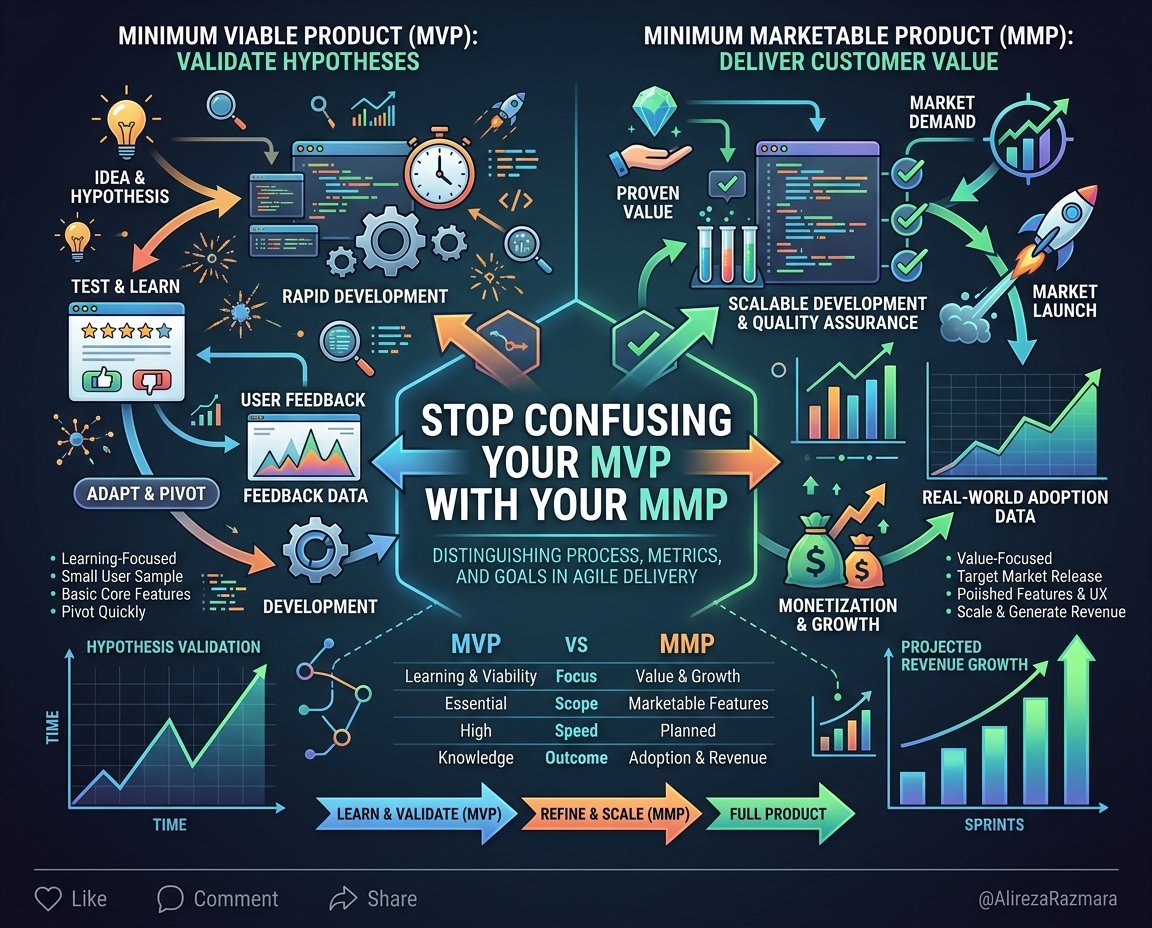
The strategic takeaway is simple: Use your MVP to discover what to build. Then, slice the scope down, refine the user experience, and ship the MMP when you are actually ready to sell.
Why Stakeholders Label Commercial Launches as “MVPs”
Stakeholders frequently label commercial launches as MVPs to intentionally bypass internal quality standards and push arbitrary deadlines. It is a common defense mechanism to justify shipping incomplete, buggy software to the market while avoiding accountability for poor product planning.
If you are an Agile practitioner, you have seen this play out in sprint planning sessions. A business leader wants a massive feature set by the end of Q3. The engineering team looks at the scope and says it will take until Q1 of next year to build it right. The stakeholder counters with a classic line: “Just give me the MVP by Q3.”
Let’s decode that statement. They do not mean “give me a lean experiment to validate a hypothesis.” They mean “cut corners on QA, skip the automated tests, ignore the technical debt, and push whatever you have to production so I can hit my launch target.”
This completely ruins the definition of “Done.” It puts developers in an impossible position where they are forced to ship code they know is flawed. It forces Product Owners into a cycle of constantly fighting production fires instead of building future value.
As a Scrum Master, Agile Coach, or Tech Lead, you have to stop this behavior in its tracks. When a stakeholder asks for an MVP, your immediate response should be: “Great. What specific hypothesis are we testing, and which closed cohort are we testing it on?” If their answer involves a press release, a marketing push, or onboarding paid users, they do not want an MVP. They want an MMP, and they need to respect the time, budget, and engineering rigor required to build it properly.
A Practical Framework for the MVP to MMP Transition
Transitioning from an MVP to an MMP requires a deliberate shift in product strategy, engineering practices, and stakeholder expectations. You must formally close the validation phase before opening the delivery phase.
Step 1: Define Validation Exit Criteria
Clearly define the exit criteria for your MVP. What specific data points tell you it is time to stop experimenting and start building? It might be a 20% conversion rate on a landing page, or ten signed letters of intent from B2B design partners. Once you hit that threshold, stop hacking things together. The validation phase is complete.
Step 2: The Throwaway Code Decision
Face the reality of your MVP code. If you built a scrappy prototype to test an idea, do not try to refactor it into a scalable enterprise application. Have the courage to throw the code away and build the MMP on a solid technical foundation. Carrying experimental technical debt into a commercial launch is a guaranteed way to slow down future velocity.
Step 3: Ruthless Scope Reduction
Take the validated learnings and identify the absolute minimum feature set required to solve the core problem. Strip away everything else. If a feature does not directly contribute to solving that primary pain point, it goes into the product backlog. Your MMP should be painfully narrow in scope but exceptional in usability.
Step 4: Upgrading the Definition of Done
Enforce strict quality standards for the MMP. The MMP must include unit tests, performance benchmarks, and a secure infrastructure. You can limit the features, but you cannot limit the quality of those features. Reset stakeholder expectations. Communicate clearly that the transition from MVP to MMP will involve a temporary slowdown in visible feature output while the team shifts from writing throwaway code to building a resilient foundation.
Protecting Your Agile Teams
Protecting your product runway means building the right thing at the right time with the right level of quality. Understanding the absolute boundary between MVP and MMP is how you achieve that balance.
Agile is about adaptability, but adaptability is not an excuse for sloppiness. You need the discipline to run fast, cheap experiments, and you need the rigor to build robust, marketable products. Draw the line clearly. Educate your stakeholders on the vocabulary. Protect your engineering teams from shifting goalposts. When you stop confusing validation with value delivery, you stop wasting money, you stop frustrating users, and you start building products that actually survive contact with the market.