
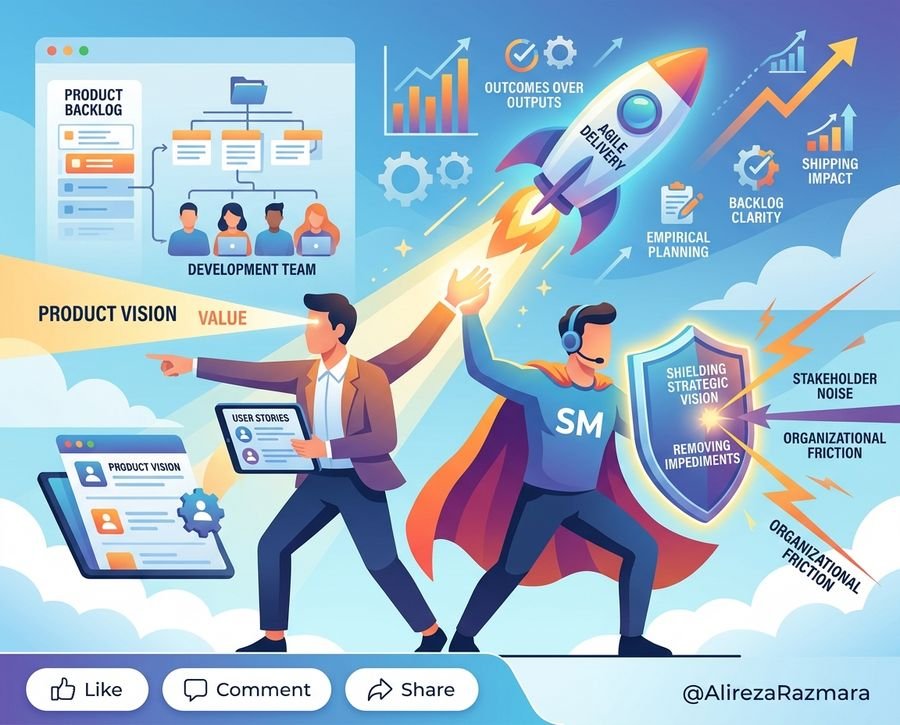
The Misunderstood Reality of Agile Leadership
Too many tech leaders and executives still operate under a dangerous misconception: they believe a Scrum Master is just a highly paid calendar admin there to run meetings for developers. That is a massive mistake. If your organization treats this role as a purely administrative function, you are leaving an enormous amount of strategic value on the table.
The true leverage in Agile delivery lies deep within the dynamic between the Scrum Master and the Product Owner. A great Scrum Master does not just coach the development team. They act as a strategic force multiplier for the Product Owner. They transform the chaotic, high-pressure demands of product management into an organized, high-velocity engine for the development team.
When this partnership is forged correctly, an overwhelmed Product Owner evolves into an unstoppable force. Here is exactly how a Senior Scrum Master elevates product delivery from merely shipping code to generating measurable business impact.
Turning Backlog Chaos into Actionable Clarity
A strong Scrum Master turns backlog chaos into clarity by coaching the Product Owner on precise story slicing, effective refinement, and defining crisp Acceptance Criteria. We do not just act as scribes for a prioritized list; we actively partner to translate vague stakeholder demands into a lean, executable framework for developers. This structural alignment prevents the team from stalling during sprint execution.
Many Product Owners inherit a massive, terrifying list of half-baked ideas, competing priorities, and vague executive requests. If developers try to pull work directly from that chaotic pile, Sprints derail instantly. The resulting friction destroys morale and tanks predictability.
A skilled Scrum Master steps in long before sprint planning begins. We look at a massive epic and ask the hard, pragmatic questions: What is the absolute smallest slice of value we can ship to validate our core assumption? We push back on vague criteria and insist on testable, binary outcomes for every user story. By forcing this discipline, we save the Product Owner from having to explain failed deliveries to the business. We ensure that when work finally hits the developers’ desks, it is sharp, clear, and ready to be built.
Empowering Empirical Product Planning
Scrum Masters empower product planning by navigating complex delivery environments using empirical data, leveraging real team capacity and historical throughput to accurately forecast releases. Strategy without realistic execution is a trap. We prevent Product Owners from making fake promises based on wishful executive thinking by anchoring roadmaps in mathematical reality.
Roadmaps often look incredibly sleek on a slide deck, but they crumble the moment they hit the development floor. Product Owners feel immense pressure from leadership to commit to specific dates for massive scopes of work. When left alone, a well-meaning PO might agree to timelines that defy the laws of software engineering.
This is where the Scrum Master brings the math. We track lead times, cycle times, velocity trends, and team capacity. When a stakeholder demands a timeline that is mathematically impossible, the Scrum Master uses these metrics to show what can actually be achieved. We run Monte Carlo simulations. We map out realistic burn-up charts. By relying on empirical data rather than gut feelings, the Scrum Master acts as the objective voice of reason. This takes the heat off the Product Owner, allowing them to negotiate scope with stakeholders using hard data rather than defensive arguments.
Shielding Strategic Vision from Stakeholder Noise
We step in to manage external pressures, protect active Sprints, and clear organizational impediments so the Product Owner can focus entirely on high-level market strategy. Product Owners are constantly bombarded by stakeholder noise. Without a dedicated Scrum Master acting as a shield, the PO inevitably degrades from a strategic visionary into a reactive order-taker.
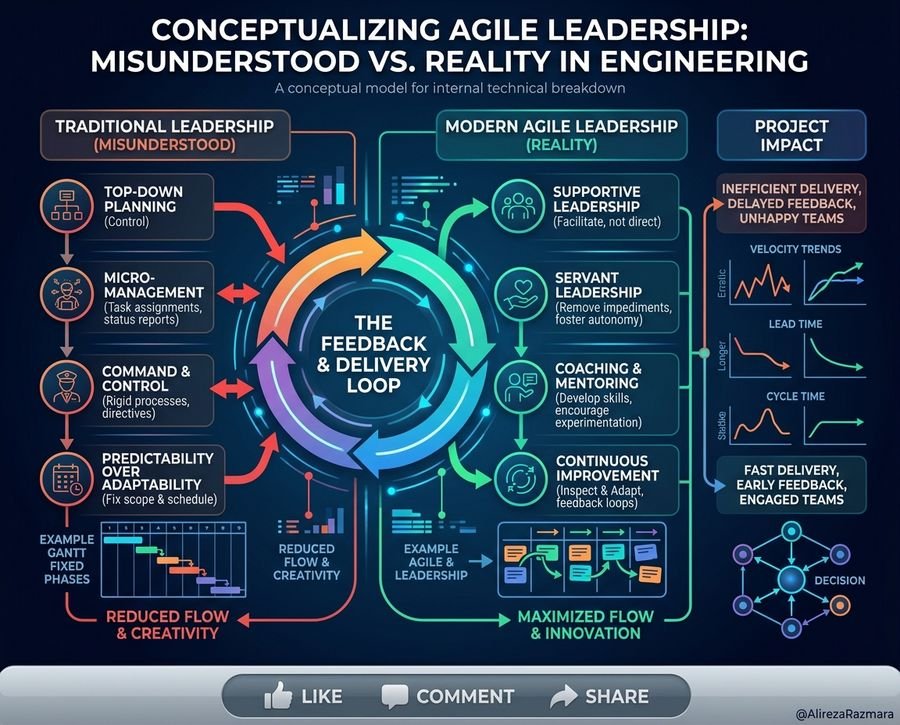
Imagine this typical scenario: Sales wants a custom integration built yesterday to close a massive enterprise deal. Marketing needs a change in the user interface by Friday to align with a new campaign. The CEO just read an article on generative AI and expects it integrated into the product immediately.
If the Product Owner handles all this friction alone, they stop doing actual product management. They lose sight of the long-term vision because they are too busy putting out daily fires. The Scrum Master acts as the definitive buffer. We intercept these disruptions. We route them through the proper backlog channels, enforce Sprint boundaries, and ensure the team is not interrupted. We clear the bureaucratic roadblocks so the Product Owner can keep their eyes on the horizon.
Shifting from a Feature Factory to Outcome-Driven Delivery
Scrum Masters guide Product Owners to define success by customer value and tangible business outcomes rather than just tracking velocity and ticket counts. It is incredibly easy for teams to fall into a feature factory mindset, where shipping code becomes the goal rather than solving actual user problems. We continuously challenge the backlog to ensure every item delivers real business impact.
Let us be entirely blunt: delivering fifty story points in a two-week sprint means absolutely nothing if the features do not move the needle on revenue, retention, or core user satisfaction. Executives love charts that go up and to the right, and sometimes Product Owners succumb to the pressure of just pushing tickets across the board to look busy.
A senior Scrum Master asks the tough, value-driven questions. During backlog refinement, we will pause and ask, “How will we actually know this feature was successful after it goes live in production?” We force the conversation away from “Did we build it fast?” to “Did we build the right thing?” By acting as a mirror for agile principles, we ensure the Product Owner remains fiercely focused on delivering highest-value items first, ruthlessly cutting scope that does not serve the immediate business goals.
Recognizing the Warning Signs of a Broken SM-PO Dynamic
A broken dynamic typically reveals itself through silent tugs-of-war: the Scrum Master focuses purely on process compliance, while the Product Owner pushes for unrealistic deadlines at the cost of technical debt. When these two roles are misaligned, team friction spikes, delivery predictability plummets, and burnout becomes inevitable. Recognizing these red flags early is critical for maintaining agile health.
- The Process Police Scenario: The Scrum Master cares more about Jira ticket hygiene and exact ceremony timing than whether the team is building a viable product. The PO views the SM as a bureaucratic hurdle rather than an ally.
- The Dictator PO: The Product Owner dictates exactly how developers should build the software, overriding team autonomy. A weak SM stands by silently instead of defending the team’s self-organization.
- The Backchannel Commitments: The PO makes secret promises to stakeholders mid-sprint without consulting the developers or the SM, leading to sudden, disruptive scope creep.
How to Rebuild a High-Performing Partnership
If you recognize those warning signs in your organization, immediate intervention is required. Transitioning from friction to a high-performing partnership requires establishing clear boundaries and deep mutual trust. Both roles must align entirely around the shared goal of delivering maximum value.
Start by co-creating the Sprint Goal. It should not be dictated by the PO, nor should it be a random collection of tickets managed by the SM. It must be a collaborative target. Second, present a united front to stakeholders. If the SM and PO disagree, they hash it out privately. In front of the business and the developers, they operate as a single, cohesive leadership unit.
When the Scrum Master and Product Owner finally operate as true strategic allies, the entire delivery ecosystem changes. Team friction drops drastically. Delivery speed accelerates safely. Most importantly, your technology teams stop just shipping code and start shipping continuous, measurable impact.