

What is Servant Leadership in Agile?
Servant leadership in Agile is the practice of relentlessly enabling your team by removing systemic blockers and protecting their focus, rather than simply managing administrative tasks. It is an active, strategic approach where leaders lower their ego to elevate the impact and autonomy of their engineers.
If your team views you as the person who just schedules meetings, takes notes, and updates Jira tickets, you are missing the mark. True Scrum Masters and Agile leaders do not manage work. They unlock human potential.
Being a servant leader does not mean being a polite order-taker. It requires courage, boundary-setting, and an obsession with eliminating friction. In the trenches of software delivery, passive administration gets disguised as leadership far too often. You are not there to ask for status updates. You are there to clear the path.
Here is how you actually demonstrate servant leadership and lead from the front by serving from behind.
1. Shield Focus Over Enforcing Rules
You protect agile teams by actively blocking mid-sprint scope creep, minimizing context-switching, and intercepting organizational noise before it reaches your developers. A true servant leader acts as a strategic shield, not a compliance officer policing the Scrum guide.
Every developer knows the pain of the “quick favor.” A stakeholder drops into Slack, asking for a tiny adjustment. Then another pings them about a bug in a legacy system. Before lunch, half the team has entirely abandoned the sprint goal to fight fires.
Your job is to step in front of that noise. When a product manager tries to inject new scope into an active sprint, you do not just point to the rulebook and say “no.” You facilitate a conversation about trade-offs. You explain the true cost of context-switching.
Actionable Strategies for Shielding Focus
- Create an intercept layer: Route ad-hoc requests through a dedicated channel or triage process that you monitor, keeping direct messages to developers quiet.
- Visualize the disruption: If stakeholders demand an interruption, explicitly pull a similarly sized ticket out of the sprint backlog. Make the cost of disruption visible.
- Stop policing, start protecting: Instead of scolding a developer for not updating a ticket, find out why they are overloaded and fix the environment causing the overload.
2. Dismantle Systemic Blockers
A Scrum Master removes impediments by navigating corporate hierarchies and cross-departmental bottlenecks to solve systemic issues, not just logging them on a whiteboard. Anyone can write down a blocker during a daily standup. A servant leader actively dismantles it.
There is a massive difference between a scribe and a bulldozer. If your team reports that they are blocked waiting on an infrastructure provisioning ticket from the DevOps team, simply adding a red flag to the Jira board accomplishes nothing. Telling the team to “follow up” is an abdication of leadership.
Servant leaders leave the team room and go to work. They hunt down the infrastructure manager. They uncover why the SLA is 72 hours. They negotiate a faster path or escalate the systemic delay to leadership so it stops happening sprint after sprint.
Actionable Strategies for Dismantling Blockers
- Follow the blocker up the chain: Do not just look at the immediate roadblock. Look at the organizational process that created it.
- Map the value stream: Identify where handoffs between departments are causing friction and propose cross-functional working agreements to streamline them.
- Take ownership of the external dependencies: Let your team focus on writing code while you focus on navigating the corporate labyrinth.
3. Foster Autonomy, Not Compliance
A servant leader fosters autonomy by shifting conversations from task completion to outcome ownership. Instead of asking if a ticket is done, you ask what support the team needs to achieve their goal. Guide the team to self-organize around solutions.
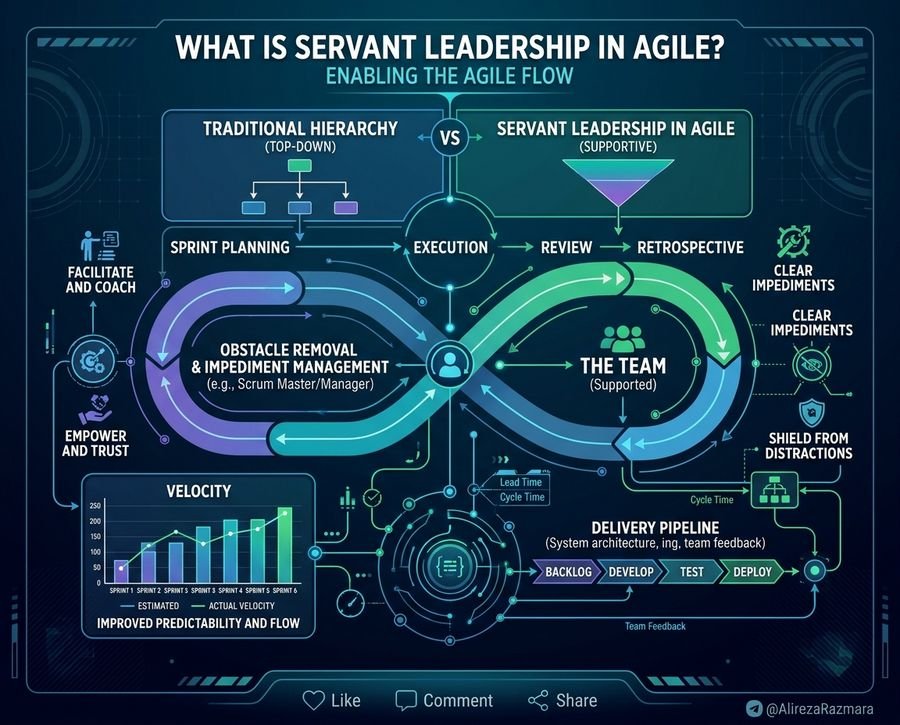
The traditional project management mindset relies on control. It treats developers like assembly line workers who need to be prodded to hit their quotas. Servant leadership rejects this entirely. If you are using the daily standup as a status report, you are building a culture of compliance.
Autonomy requires trust. You must trust that your team has the technical expertise to figure out the “how” once the product owner defines the “what.” Your role is to build the guardrails that allow them to run fast safely.
Actionable Strategies for Fostering Autonomy
- Change your questions: Stop asking, “Did you finish that task?” Start asking, “What support do you need to own this outcome?”
- Encourage peer-to-peer accountability: Step back during team meetings. Let engineers answer each other’s questions instead of routing all communication through you.
- Celebrate autonomous decisions: When the team pivots their technical approach to solve a problem faster, highlight that adaptability during the sprint review.
4. Build Psychological Safety
You build psychological safety by modeling vulnerability and replacing blame with curiosity during failures. When deployments break or sprint goals are missed, the focus must shift to what the system can learn rather than who made the mistake.
Software engineering is complex, and failure is an inevitable part of innovation. If your team is terrified of making a mistake, they will hide bugs, artificially inflate estimates, and avoid taking technical risks. Innovation dies in a culture of fear.
When a severe production incident occurs, a servant leader sets the tone. They do not ask, “Who pushed that bad commit?” They ask, “What gap in our deployment pipeline allowed this to slip through?” They create an environment where engineers feel safe raising their hands and admitting they need help.
Actionable Strategies for Building Safety
- Run blameless post-mortems: Structure your retrospectives around systems, processes, and tooling gaps, entirely separating the problem from the person.
- Model vulnerability: Openly admit your own mistakes. If you facilitated a poor planning session, own it. Lead by example.
- Protect the messengers: When an engineer brings bad news—like a major architectural flaw—praise them for their transparency in front of the group.
5. Coach the Business, Not Just the Squad
Scrum Masters must coach the business because true agility fails if stakeholders do not understand realistic capacity, value delivery, and the cost of delay. Enabling an engineering team requires an educated organizational environment that understands agile mechanics.
You can build the most high-performing, hyper-focused engineering squad in the world, but if the surrounding organization operates like a traditional feature factory, your team will eventually burn out. Stakeholders who demand fixed-scope, fixed-time, and fixed-budget projects are fundamentally incompatible with agile software development.
Servant leadership extends beyond the developers. You have a duty to serve the product leaders and the broader organization by educating them. You must translate technical realities into business impacts.
Actionable Strategies for Coaching the Business
- Visualize the cost of delay: When stakeholders argue over competing priorities, help them quantify the financial impact of delaying specific features.
- Teach capacity planning: Show leadership exactly how technical debt, maintenance, and context-switching eat into feature delivery time.
- Redefine success metrics: Coach executives to stop measuring success by lines of code or velocity, and start measuring it by customer value delivered.
The Bottom Line: Servant Leadership is an Active Strategy
Servant leadership is not passive. It is a strategic, courageous act of leveraging your influence to clear the path for others. It requires you to step into conflict, push back against toxic organizational habits, and create a protective bubble where brilliant engineers can do their best work.
When you measure your success solely by the growth, autonomy, and impact of your team, magic happens. You stop managing work and start leading people.