
🎧 Listen In: How Scrum Masters Fix Zombie Retrospectives (18 min)
Is your Sprint Retrospective a powerful engine for continuous growth, or just a glorified 60-minute complaint session? For many software engineering teams, the bi-weekly retro has devolved into a tedious calendar obligation. Team members stare blankly at a digital whiteboard, list a few minor grievances, and return to their code without changing anything fundamental about how they work.
The difference between a zombie meeting and a high-performance growth engine almost always comes down to what the Scrum Master actually does in the room.
To many tech leaders and developers, it seems like the Scrum Master is just there to book the calendar invite, ask, “What went well?”, and write down sticky notes. In reality, an effective Scrum Master acts as a neutral facilitator, behavioral coach, and continuous improvement catalyst. They do not fix problems for the team; they cultivate an environment where the team continuously heals and upgrades itself.
What is the True Role of a Scrum Master in a Retrospective?
A Scrum Master’s true role in a Retrospective is to act as a behavioral coach and process catalyst, rather than a traditional project manager. They guide the team to systematically diagnose workflow friction, uncover hidden root causes, and design measurable experiments to improve the next sprint.
If a Scrum Master is simply reading off a list of complaints and assigning Jira tickets, they are shortchanging the team. A high-impact Scrum Master operates on a deeper level, managing team dynamics, neutralizing power imbalances, and forcing abstract problems into concrete action. Here is exactly what top-tier Scrum Masters do behind closed doors to build elite delivery teams.
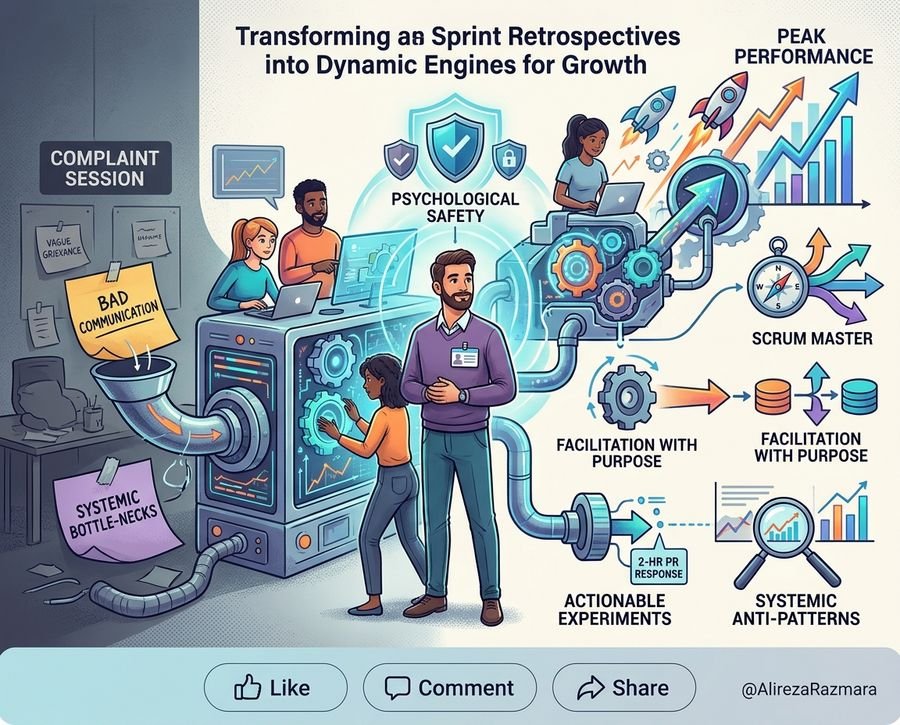
1. Engineering Psychological Safety and a Blameless Culture
Psychological safety is the shared belief that a team environment is safe for interpersonal risk-taking without fear of humiliation or punishment. In a Retrospective, the Scrum Master actively engineers this safety by enforcing a blameless culture focused strictly on systemic failures rather than individual mistakes.
Without psychological safety, your Retrospective is just a status update wrapped in fake smiles. Developers will hide critical errors, downplay technical debt, and offer safe, superficial feedback. The Scrum Master establishes the baseline rules of engagement, often anchoring the room to Norm Kerth’s Prime Directive: “Regardless of what we discover, we understand and truly believe that everyone did the best job they could, given what they knew at the time, their skills and abilities, the resources available, and the situation at hand.”
When a deployment crashes production or a sprint goal is missed, a skilled Scrum Master intercepts any finger-pointing. If a junior developer admits they rushed untested code that broke the build, the Scrum Master pivots the conversation away from the individual. They ask the room, “What gaps in our CI/CD pipeline allowed untested code to reach production?” By shifting the focus from who failed to where the system failed, the Scrum Master transforms anxiety into productive problem-solving.
2. Facilitating with Purpose, Not Authority
Effective facilitation means guiding a group to discover their own solutions using structured frameworks, rather than dictating orders. A Scrum Master utilizes varied techniques to neutralize power dynamics and ensure every team member contributes equally to problem-solving.
Relying solely on “Mad, Sad, Glad” every two weeks leads directly to retrospective fatigue. Experienced Agile coaches pull from a wide, dynamic toolkit to keep the team engaged and thinking critically.
- Liberating Structures: Techniques like 1-2-4-All ensure that quiet developers have the exact same voice as the loudest senior architect. It prevents the HiPPO effect (Highest Paid Person’s Opinion) from dominating the room.
- The Sailboat Retro: Visual metaphors help teams map out the “wind in their sails” (what pushes them forward) and the “anchors” (technical dependencies dragging them down).
- The 5 Whys: When an issue surfaces, the Scrum Master uses root-cause analysis frameworks to strip away superficial symptoms and expose the core workflow failure.
The golden rule of facilitation is neutrality. The Scrum Master does not own the solution; they own the process of arriving at the solution.
3. Refactoring Vague Whining into Actionable Experiments
Transforming complaints into experiments requires taking subjective feedback and applying measurable, time-boxed workflow adjustments. The Scrum Master forces the team to clearly define what they will change next sprint and exactly how they will measure its success.
Vague feedback yields zero results. If a team leaves a Retrospective agreeing to “communicate better” or “do more testing,” the meeting was a failure. The Scrum Master’s job is to intercept these broad, useless complaints and refactor them.

Imagine a developer complains, “Code reviews are taking too long and blocking my tickets.” A weak facilitator writes “Slow PRs” on the board and moves on. A strong Scrum Master pauses the room. They push for specificity and help the team design a scientific test for the next sprint.
The vague complaint becomes a clear, trackable experiment: “For Sprint 44, we will implement a 2-hour cap on PR review response times, and we will configure GitHub to ping the Slack channel when a review has stalled. We will review the cycle time metrics at the next retro to see if velocity improved.” By treating process changes as temporary scientific experiments, teams reduce the fear of commitment and iterate on their workflows significantly faster.
4. Detecting Systemic Anti-Patterns Across Sprints
Systemic anti-patterns are recurring workflow bottlenecks, technical debt trends, or organizational dysfunctions that span multiple development cycles. The Scrum Master tracks these long-term data points to identify issues that require escalation beyond the immediate team.
While software engineers are deep in the codebase trying to ship features, they often miss the forest for the trees. The Scrum Master acts as the team’s diagnostic engine. They connect the dots across months of sprints to spot the insidious trends that kill velocity over time.
They track behavioral and delivery data points that others ignore. If the QA phase consistently compresses into the final 24 hours of every sprint, the Scrum Master highlights this testing bottleneck. If story point estimates are repeatedly blown out of proportion due to undocumented legacy code, they bring the historical data to the Retrospective to force a conversation about tech debt allocation.
Crucially, an experienced Scrum Master knows the limits of the team’s agency. When internal workflow tweaks are not enough to solve a problem, they take on the role of a heat shield. They escalate systemic blockers, cross-team dependencies, and tooling limitations to senior technical leadership, fighting the battles the developers shouldn’t have to fight.
5. Protecting Team Energy and Celebrating Wins
Protecting team energy involves actively managing morale and preventing burnout by recognizing progress and momentum. The Scrum Master ensures the team celebrates incremental victories just as rigorously as they dissect their technical failures.
Software delivery is an exhausting, high-pressure grind. A Retrospective that focuses entirely on broken builds, missed deadlines, and flawed code will quickly drain a team’s morale. High-performing engineering teams run on momentum, and momentum requires recognition.
A great Scrum Master intentionally engineers moments of celebration. Acknowledging the database engineer who stayed late to crush a nasty production bug, or praising the Product Owner who wrote exceptionally clear acceptance criteria, builds team resilience. This is not about forced applause or toxic positivity. It is about acknowledging hard work and explicitly reinforcing the specific behaviors you want to see repeated in future sprints.
A balanced Retrospective ensures the team leaves the room energized, aligned, and ready for Monday morning, rather than dreading the next backlog refinement.
The Mark of a Masterful Facilitator
An exceptional Scrum Master makes themselves progressively less necessary over time. By installing robust communication habits, coaching peer-to-peer accountability, and driving continuous process experimentation, they build truly self-organizing teams.
If your Retrospectives feel like a chore, take a hard look at the facilitation happening in the room. Are you just reading off sticky notes, or are you actively shaping the behavioral dynamics of your engineering team? Shift your focus from administrative meeting management to high-impact behavioral coaching, and watch your team’s delivery metrics transform.