
Listen In: Should Retrospective Action Items Be Tickets (18 min)
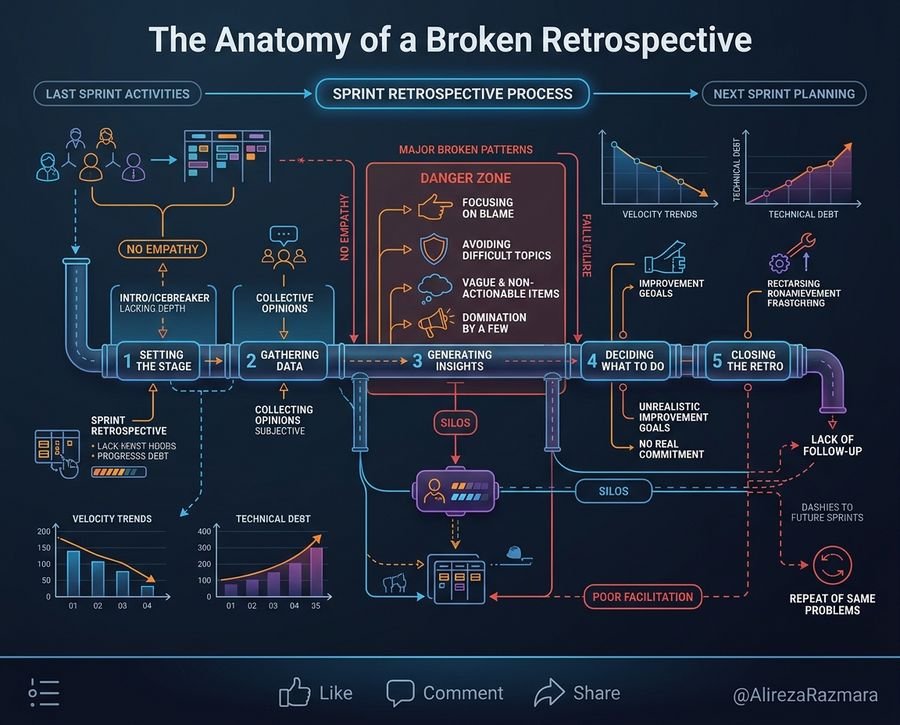
The Anatomy of a Broken Retrospective
“We’ll definitely get to these action items next sprint.” I hear this phrase constantly. It is, without a doubt, the most common lie told in Agile software development.
How many times has your team held a brilliant Retrospective? You sit in a room—or on a video call—and generate gold-standard improvement ideas. The conversation is rich. The team identifies massive bottlenecks in the CI/CD pipeline, communication gaps with stakeholders, and painful manual testing steps. Everyone nods. Everyone agrees. Then, you watch those brilliant ideas gather digital dust until the sprint ends. The deadline quietly passes, and the cycle repeats.
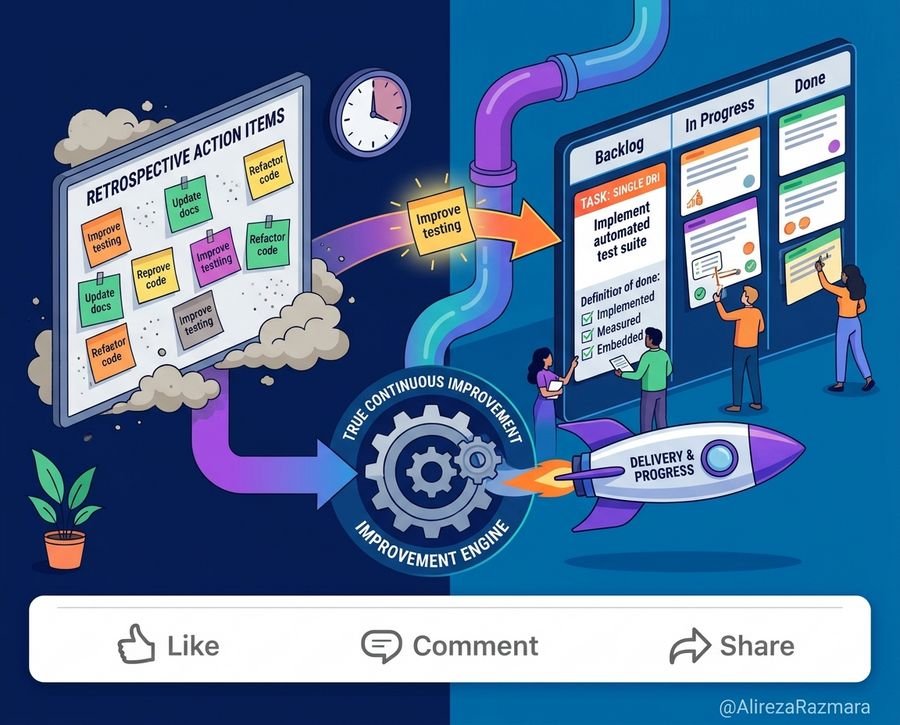
Action items aren’t optional wishlist items. They are the absolute engine of true continuous improvement, or Kaizen.
Why do sprint retrospective items consistently fail? They fail because teams treat them as optional, extracurricular homework rather than core sprint deliverables. To guarantee your team delivers action items before the deadline—without micro-managing—you must integrate improvements directly into the sprint backlog, limit work in progress, and assign clear, singular ownership.
Here is the practical, field-tested framework I use to stop the endless cycle of neglected retrospective items.
Put Them on the Sprint Board
You must put action items on the active sprint board to make them visible, prioritized, and trackable alongside your standard product work. If an improvement item isn’t highly visible on your current board, it simply does not exist to the delivery team.
Stop putting retrospective output into a separate spreadsheet. Stop leaving them as bullet points at the bottom of a Confluence page that nobody will open until the next retro. Convert retro action items into actual Sprint Backlog tasks. Give them estimates. Write clear acceptance criteria for them. Move them through your standard workflow columns: To Do, In Progress, Review, and Done.
When you treat process improvement with the exact same respect as product features, you change the team’s psychology. If a developer needs to dedicate four hours to automating a manual QA step, that is four hours of capacity that cannot go toward building a new feature. Putting it on the board forces the Product Owner and the broader business to acknowledge the reality of capacity constraints. It makes the invisible work visible.
Limit WIP on Improvements
Limiting Work in Progress (WIP) on continuous improvement prevents teams from taking on more change than they can realistically handle. You should focus purely on execution over ideation by selecting exactly one or two high-impact action items per sprint.
Successfully finishing one meaningful change beats failing five half-baked promises every single time. Retrospectives naturally generate a massive list of complaints and corresponding solutions. It is incredibly tempting to grab the top five ideas and commit to all of them, especially when team morale is high at the end of a great meeting. Do not do this.
Process change requires behavioral change, and human beings have a strict limit on how much behavioral change they can process at once. Force rank your improvement ideas. Pick the single biggest bottleneck impacting your delivery pipeline right now. Fix that one thing completely. Let the rest sit in a dedicated continuous improvement backlog.
When you aggressively limit WIP on process improvements, you build a track record of actual delivery instead of a backlog of guilt. Your team learns to trust that when an item is selected, it actually gets done.
Single Ownership, Collective Accountability
Assigning a single Directly Responsible Individual (DRI) to an action item prevents the bystander effect common in agile teams. In team environments, saying “the team owns this” almost always translates directly to “nobody owns this.”
You need one specific person accountable for driving the item forward, even if multiple people contribute to the execution. This does not mean the assigned individual operates in a silo or does all the heavy lifting alone. Think of the DRI as a micro-project manager for that specific task.
They are the person who sets up the pairing session. They are the person who flags blockers during the daily stand-up. They are the person who ensures the ticket is moving across the board. When you attach a name to a process improvement, you eliminate ambiguity. People know exactly who to talk to regarding that specific change, and the individual feels a professional obligation to see it through to completion.
Shift-Left Your Check-ins
Shifting left on retrospective items means discussing their progress early and often during the sprint, rather than waiting for the final days to panic. You must integrate action item updates into your Daily Scrums and mid-sprint check-ins to ensure steady progress.
Early and consistent visibility eliminates deadline-driven anxiety. Far too many Scrum Masters wait until the start of the next Retrospective to ask, “So, how did we do on our action items?” By then, it is entirely too late. The sprint is over, the context is lost, and the opportunity for course correction has passed.
Change the structure of your Daily Scrum. After reviewing the product increment progress, explicitly point to the action item ticket on the board. Ask the DRI for a brief status update. If it is blocked, swarm on it just as you would a critical bug in production. By talking about process improvements on day two, day four, and day six of the sprint, you normalize them as standard daily work.
Defending Improvement Time from Stakeholders
You defend time for retrospective action items by communicating their direct impact on future delivery speed and product quality to your stakeholders. Frame process improvements as technical debt reduction rather than non-value-added administrative tasks.
Often, the reason action items get dropped isn’t because the team is lazy. It is because a Product Manager or stakeholder pressures the team to squeeze in “just one more feature” mid-sprint. When push comes to shove, the internal process improvement is the first thing abandoned.
As an Agile Coach or Scrum Master, you must fiercely protect this time. When stakeholders push back on the capacity dedicated to an action item, translate it into their language. Do not say, “We need to improve our internal deployment scripts.” Say, “We are investing four hours this sprint to reduce our deployment time by 50%, which will allow us to ship your features faster every single sprint moving forward.” Link the process improvement directly to business value.
Build a “Definition of Done” for Actions
A Definition of Done (DoD) for action items guarantees that an improvement is fully implemented, objectively measured, and deeply embedded into the team’s workflow. An action item is never considered done simply because a conversation happened or a meeting was scheduled.
We have strict criteria for product features. Code must be reviewed, tested, and deployed to a staging environment before it can be marked complete. We need the exact same rigor for our process improvements.
If your action item is “Improve our deployment documentation,” what does “done” actually look like? Done means the wiki is completely updated, a new engineer has successfully used the documentation to run a dummy deployment without asking for help, and the permanent link is pinned in the team’s Slack channel. When you establish strict, verifiable completion criteria for actions, you stop closing tickets just to feel good. You close them because real, tangible change occurred.
Measuring the Impact of Your Action Items
Measuring the impact of your action items requires tying your process improvements directly to core agile metrics like cycle time, deployment frequency, or defect rates. You must prove that the time invested in the action item yielded a tangible return on investment.
It is not enough to just finish the task and move on. If your team spent hours automating a testing script, track how much time it actually saves the team over the next month. If you changed your refinement process to reduce unestimated stories, measure your sprint planning efficiency before and after the change.
Bring these metrics to your future retrospectives. When a team sees that an action item they completed three sprints ago permanently reduced their bug count by 20%, it creates a powerful feedback loop. They stop viewing continuous improvement as a chore and start viewing it as a massive lever for making their own lives easier.
Transforming Intent into Delivery
When you stop treating action items as extra homework and integrate them directly into your delivery pipeline, everything changes in your agile environment. Deadlines stop being a looming threat. They start becoming milestones of real, measurable progress.
Agile isn’t about talking about getting better. It is about the ruthless, systematic execution of getting better. Stop building wishlists that nobody looks at. Start building sprint-ready improvement tasks. Keep them highly visible, keep your commitments severely limited, enforce strict ownership, and watch your team’s delivery capabilities compound sprint after sprint.