
You get a ping on Slack from the Director of Engineering or a well-meaning Product VP: “Can I sit in on your Sprint Retrospective today? I just want to hear the blockers firsthand.”
It sounds entirely harmless. As an Agile Coach or Scrum Master, you know their intent is almost always positive. They want to help, support the team, and remove impediments. It feels incredibly difficult to tell a senior leader they cannot attend a meeting, especially when they hold the authority to actually fix the organizational friction slowing your team down.
But this is one of the most critical leadership tests you will face. Yielding to this request fundamentally alters the core dynamics of the Scrum Team. You are not just managing a calendar invite; you are defending the psychological safety of your engineers.
Should Managers Attend Sprint Retrospectives?
No, managers should generally not attend Sprint Retrospectives unless explicitly invited by the development team for a specific, time-boxed topic. The retrospective is a dedicated, private event for the Scrum Team to openly discuss failures, internal friction, and process improvements without fear of judgment or performance evaluation.
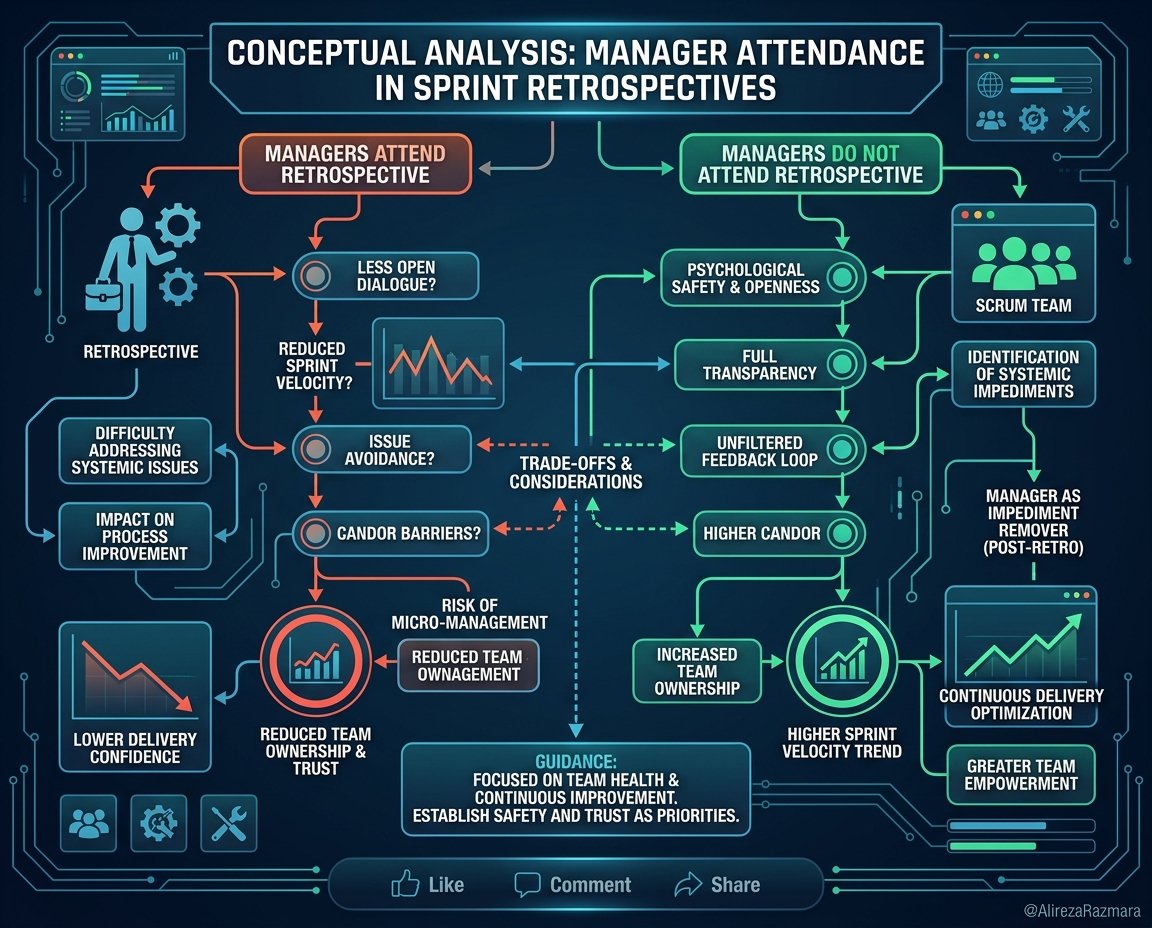
Here is the hard truth about team dynamics: the moment authority enters the room, candid honesty leaves it. Even the most empathetic, emotionally intelligent leaders unknowingly shift the atmosphere.
When a manager sits in, developers stop looking at how they can improve their messy internal handoffs and start curating their words. Genuine self-reflection morphs into polished self-preservation. Instead of admitting, “I really messed up the database migration because I rushed the testing phase,” an engineer will pivot to, “We experienced some unexpected latency issues during deployment.”
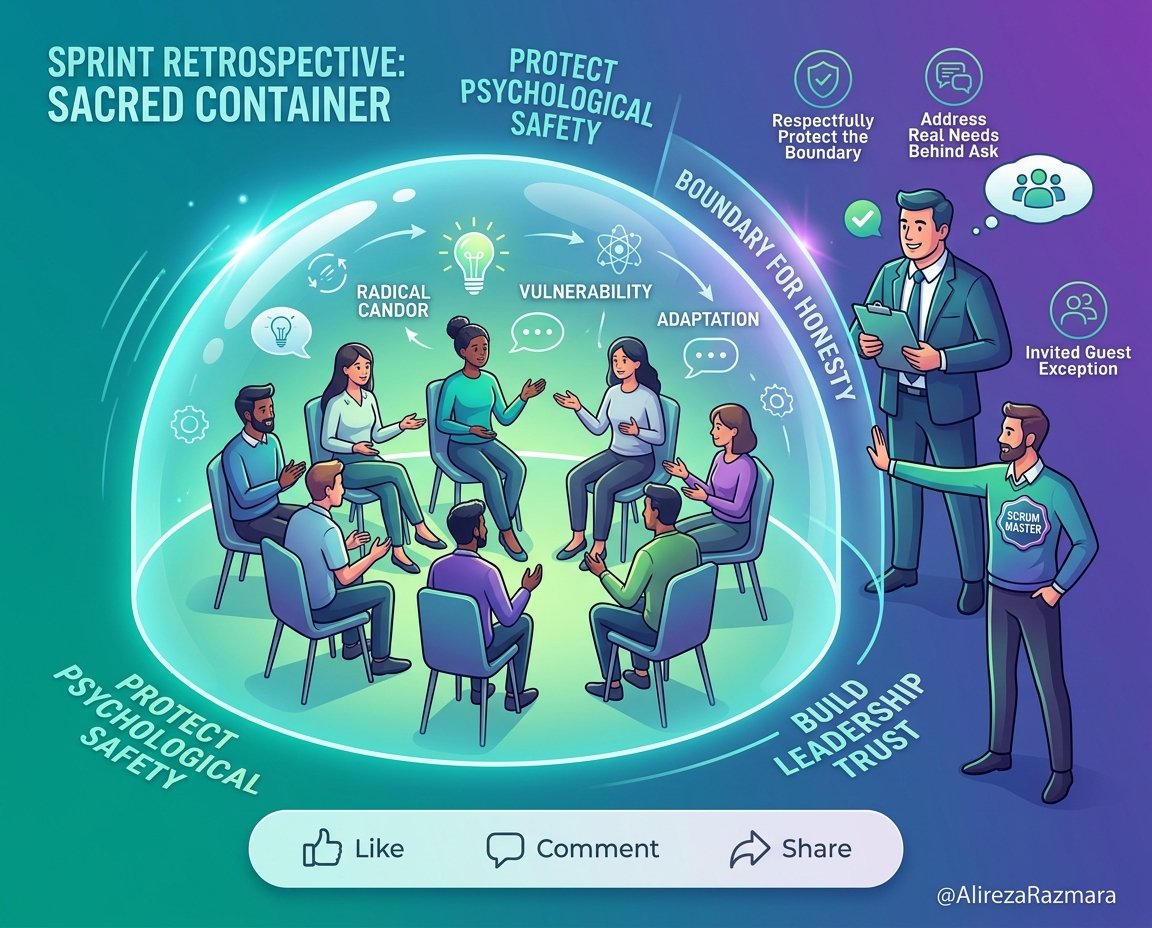
Retrospectives are not status meetings. They are not reporting sessions. They are a sacred container for vulnerability, radical candor, and internal adaptation. If the team feels they are being observed by leadership, the retrospective turns into a sanitized performance, destroying its entire purpose.
Respectfully Protecting the Boundary: How to Say No
To respectfully decline a manager’s request to attend a retrospective, acknowledge their positive intent to help, firmly state the team’s need for a private space, and offer an alternative way to share blockers. You must protect the boundary while keeping the leader engaged as an ally.
Saying “no” to a boss or a major stakeholder is daunting, but doing it effectively establishes your credibility. You must frame the rejection not as keeping secrets, but as protecting a structural necessity of Agile.
Here is exactly how you can script this conversation:
The Acknowledgment: “I really appreciate you wanting to jump in and help unblock the team. We definitely have some systemic issues this sprint that require your influence.”
The Boundary: “However, I keep the retrospective strictly closed to just the core Scrum Team. This ensures the engineers feel entirely safe to debate internal mistakes and process failures without worrying about how it looks to leadership.”
The Alternative: “Instead of having you sit in, I am going to compile the exact blockers we need your help with and bring them straight to you right after the meeting finishes. Does that work for you?”
Occasionally, a manager will push back. They might say, “I promise I won’t talk. I’ll just be a fly on the wall. I’m not evaluating anyone.” Hold your ground. Explain that their physical presence alone changes the social equation. A fly on the wall is still an observer, and teams behave differently when observed.
Addressing the Real Need Behind the Ask
Managers usually ask to attend retrospectives because they lack visibility into team struggles, want to escalate severe blockers, or genuinely desire to support the team. You can fulfill these needs through transparent impediment backlogs and post-retro summaries rather than granting meeting access.
When a leader asks to bypass a boundary, they are usually trying to solve a problem. If you just say no without addressing their underlying anxiety, you will eventually lose their support. You need to build mechanisms that give them the visibility they crave without compromising the team.
Share High-Level, Anonymized Improvement Themes
Leaders want to know the team is actually improving. After the retrospective, send a brief summary to management. The trick is to focus entirely on the what, not the who.
Instead of: “Sarah and John are fighting over code review response times,” write: “The team identified bottlenecks in the code review process and agreed on a new working agreement to review PRs within 24 hours.” This shows leadership that the team is handling its business effectively.
Maintain an Organizational Impediment Backlog
If management wants to hear about blockers firsthand, make those blockers highly visible all the time. Create a dedicated space—a specific Jira board, a Confluence page, or a physical wall—called the “Organizational Impediment Backlog.”
When the team identifies a blocker during the retrospective that they cannot solve themselves (like cross-departmental dependencies, budget for better tooling, or vendor issues), the Scrum Master moves that item onto this board. Management can review this board daily. It explicitly invites leadership to act on the team’s behalf, transforming them from observers into active problem solvers.
The Exception: An Invited Guest with Team Consent
A manager can attend a retrospective if the Scrum Team actively requests their presence to solve a specific, systemic blocker. This attendance must be strictly regulated with a pre-agreed agenda, a tight timebox, and complete team consensus beforehand.
There are rare moments when having a leader in the room is highly beneficial. Perhaps the team is continually failing sprints because the sales department keeps promising custom features without consulting engineering. The team might say, “We need the Director of Product in here to help us figure out how to stop this pipeline bleed.”
If the team issues the invitation, you as the Scrum Master must facilitate the engagement with strict ground rules to ensure it does not derail the entire event.
- Total Consensus: Ask the team privately if they want the manager there. If even one person is uncomfortable, the manager does not come in.
- Pre-Agreed Agenda: The manager is not there to listen to the whole retro. They are there for one specific topic. Define that topic clearly before they enter the room.
- Dedicated Timebox: Allocate exactly 15 or 20 minutes for this discussion. When the time is up, cut it off.
- Leave Promptly: Once the specific agenda item is concluded, politely excuse the manager. “Thanks so much for hashing this out with us, Dave. We are going to spend the last 30 minutes going over our internal code quality metrics. We will follow up with you on those action items tomorrow.”
By treating the manager as an invited guest rather than a permanent fixture, you maintain the team’s ownership over the meeting space.
Building a Culture of Trust and Servant Leadership
True servant leadership means creating an environment so safe and structurally sound that teams can solve their own problems, trusting them to do so without constant oversight. It is about removing organizational friction from the outside rather than micromanaging from the inside.
Every time you successfully protect the retrospective boundary, you send a powerful message to your developers: I have your back. This is your space. Over time, this builds an immense reservoir of trust. Teams that feel safe enough to brutally dissect their own failures are the teams that deliver high-quality software predictably.
For managers, learning to step back is often counter-intuitive. They reached their positions by being deeply involved problem-solvers. But leading Agile teams requires a different approach. You have to trust the framework. You have to trust that the Scrum Master is facilitating healthy conflict. And most importantly, you have to trust the engineers to diagnose their own ailments.
Your job as an Agile practitioner is to bridge that gap. Keep the retrospective sacred, but keep the communication lines wide open. When leadership sees that teams are proactively removing their own blockers and asking for help only when truly needed, the requests to “just sit in and listen” will eventually stop. They will realize the system works best when they focus on clearing the road ahead, rather than watching the engine run from the backseat.